Monday, April 13, 2015

2 of Swords: Eye of the Hurricane

The 2 of Swords is a great card.  It speaks eloquently of an experience we've all had at one time or another in our lives; a very specific moment, a frame of mind whose presence in the deck demonstrates so well just how aptly the Tarot can highlight our at-times subtle, yet poignant, dilemmas. So what does it mean? Denial? Avoidance? Inner peace? Inability to make a decision? Yeah, sure, it can be all of those things, and yet its cooked-down essence is far more interesting than any of those things.

First I want to briefly discuss that essence, and then I want to explore a few different manifestations of it across a selection of decks....

The 2 of Swords is actually rather painful, or at best uncomfortable. I like the "inner peace" idea, but the peace here not a harmonic one; it is more of a tentative pause, or momentary withdrawal from a struggle, kind of like the eye of a hurricane. But the hurricane is not a tempest ripping trees out by the roots around you; rather it occurs within you. If anything, the "peace" is what happens around you while your insides are threatening to knock you to your knees. Someone could look at you and see a perfectly calm, relaxed individual, never sensing the turmoil happening within.

The 2 of Swords is about facing a decision, yes. A decision between two crucial options where one is neither considerably better, nor considerably worse, than the other.....and yet, in the end, you must choose one, or else risk one of them being chosen for you (which isn't really the way you want to go down, now is it!).

In effect this is a formal "draw" of the intellect. In some cases there may be some amount of denial, but oftentimes there is perfect clarity about what is to be done (this, or that), but the seeming impossibility of the choice to be made leads the person in question to put it off for as long as possible.

This is the essence of the 2 of Swords.

Silver Witchcraft Tarot

I love this version from the Silver Witchcraft Tarot. This woman sits in the snow as if frozen in time, an athame in each hand. Roses or daisies? She is blindfolded and can't see the outcome of the decision that she will have to make. She weighs the blades in either hand, trying to sense which might be best, but their heft is the same. Butterflies surround each blade, suggesting that perhaps either choice will be okay when all is said and done. And in the end, when she finally makes her choice, she will only see roses, or daisies. She won't see what might have been, only what is. Fortunately, both flowers are beautiful, both smell sweet - they are different from each other, but both offer something positive.


Anna K Tarot

The depiction in the Anna K Tarot is quite apt for the energy of this card. A man stands inside the warmth of a building, perhaps his home. He looks away from the open and unguarded doorway, where two swords stand blocking the raging sea beyond. The moon shines above, his feelings are in uproar. The two swords almost seem to protect him, but they can't really do the job; the sand is already pushing inside. This man is taking a final moment of tranquility to gather his thoughts, but very soon he'll have to face his decision, pulling the swords out of the ground, and confronting the moon beyond.

Deviant Moon Tarot

The Deviant Moon 2 of Swords shows the inner battle being fought between two equally viable, and perhaps equally challenging, possibilities. There is a single pair of legs, with two torsos facing each other - a man battling himself. What I like about this version is that it highlights the inner conflict inherent in being at a crossroads where one path must be selected, and though the potential consequences may be great, they are essentially unknowable. There is no clear, best way.

When this card appears in a reading you might ask yourself:

What decision am I struggling to make?
What might help me achieve clarity regarding my current situation? 
What are the positives in each option?
What, if any, are my deal-breakers?
What can I live with, even if it isn't ideal?
What am I most afraid of?
How realistic are my fears?  

Don't forget that sometimes it's best to let things simmer for a while. If you aren't pressed to sign a contract, put it on the back burner for some time and try to see the forest for the trees: drink good tea, watch some bad T.V., and come back to the issue when the pressure has eased. You never know what helpful insights will pop up when you set your intellect to "idle" for a little while.

Saturday, April 11, 2015

A Road Map to Peace

I was watching Telemundo a few days ago when a Tarot reader popped on the screen to give each astrological sign a mini (as in 5 second) reading for the week. My first thought was: "They would never have a regular reader like this on English-language television." And then I took a look at his cards. I noticed that he was using a combination of two decks: an oracle that I didn't recognize, and the Osho Zen Tarot. For each sign he would pick a card from each deck, give rapid advice, and move on to the next. I wondered if he chose the Osho Zen deck because each card features a keyword that the reader could latch onto, which would facilitate this quick-fire style he was using in order to fit into his very limited time bracket. Or maybe he just thinks it's pretty.

It certainly has vibrant colors, and works as both a Tarot and an oracle, really. I decided to pull my own Osho Zen deck out for some general guidance, because I have a lot on my plate at the moment! I centered on the question: "What do I need to focus on in order to find peace and clarity?"

I pulled: 4 of Earth (The Miser), XVII Star (Silence), and XIV Temperance (Integration).

Osho Zen Tarot
Osho and Ma Deva Padma
St. Martin's Press, 1995

The Miser sprouts out of a stone wall, embracing mounds of gold and gems. She doesn't want to let go, but she doesn't look particularly healthy in her current situation. This makes sense to me, because in many ways I've been very focused on stability and security lately. In one important way I'm reluctantly anticipating some pretty big changes coming up that will impact my environment significantly, albeit for a finite amount of time. My husband is preparing to return to Europe for work, and may be gone for several months. Meanwhile my children will be heading north to spend eight weeks with their grandparents, as soon as school lets out for summer. Intellectually I can understand how all of this makes sense, and I know that it's temporary, and I am aware that there are many positives to this arrangement of events. But on an instinctual level I'm fighting it tooth and nail. I don't want my husband to be away again for three or more months, and I'm deeply frustrated that suitable work opportunities haven't presented themselves locally. I'm glad that my kids will spend time with my mother and step-dad. I know they'll have fun, and I know that they'll have more of a true vacation than I would be able to give them due to my own work schedule. But I can't stand the thought of them being gone for so long. It feels unnatural. So while I "know" everything will be fine, on a primal level I'm holding on tightly to everything.

All of that internal grappling is giving me a headache.

The Star in the Osho Zen deck is called "Silence." Just looking at the card reminds me of the peace of meditation, the centeredness that comes from spending some time going within. A face floats in space, stars hanging above, with the Moon shining over this person's 3rd eye. The Moon represents my fears, the dreaded anticipation of what's to come. Instead of fighting against it, I must invite it in and sit with it. What am I resisting? What am I afraid of? What's real and what's illusion? The Star encourages me to tap into my heart, to have faith that if I let go, things will be okay. When I'm feeling worried, I can close my eyes, and open myself to the guidance that is always available via my higher self, and the spirits that surround me.


The final card, Temperance, is titled "Integration." The instinctual over-attachment in The Miser has been illuminated and eased by the Silence in the Star, and has now reached a healing balance. This card tells me to honor my experience rather than trying to gloss over it. It doesn't have to feel good, and I don't have to reach a point where the lack of stability in my household doesn't bother me at all. All I have to do is understand that those feelings don't have to dominate my being. I will be able to visit my kids up north for a week or so, about half way through their visit. It won't be eight weeks straight with no contact. There is benefit to spending some time focusing on my Self, and I am very aware of how busy I am, and how little time I have for solitude. My husband will miss us, and we'll miss him, but I also know that the opportunity awaiting him is a very positive one, and that he needs to take advantage of it, for a multitude of reasons. I know it won't last forever, and he'll be back sooner than I think. I know that my children will have many adventures, and many stories to tell their friends when the school year starts again in August. I love that they will spend so much time with their grandparents, especially because since we live so far apart, quality time is more difficult to achieve.

In the color scheme of this reading, I see the sickly green of the Miser fade into the deep blue of inner mystery and hope, then bursting forth in the harmonic joy of rainbow colors in Temperance. It's a road map to peace. I think I'll frame it. ;-)

Monday, April 6, 2015

Deck Review: The Baseball Tarot

As I sat at my dining room table today, munching on a "party cake" flavored Peep (yes, it's pretty much as disgusting as it sounds), and sipping on a steaming mug of oolong tea, my eye wandered over to my divination shelf. I'm not sure why the Baseball Tarot called my name today (maybe because baseball fans are gearing up for the season?), but I decided to go with it!

This is a deck I never use, but I like it. It cost me less than a dollar online about a year ago, and at the time I figured that I couldn't go wrong at that price, so I pulled out my wallet and sent an e-penny through cyberspace. A couple of weeks later (it got lost in the mail) it finally arrived on my doorstep, the cards still wrapped in their cellophane from 1999.


The Baseball Tarot: Workman Publishing, 1999

The Baseball Tarot, by Mark Lerner and Laura Philips, would obviously be an excellent fit for a baseball fan - not even just a passing admirer of the sport, but someone who truly adores the game, and perhaps also happens to enjoy Tarot. Like most decks that feature a theme, most of the cards depict images or code words (like "Pick Off" or "Take") that the lay-person may not understand, or immediately associate with Tarot archetypes. Nevertheless, if you already understand the structure of a Tarot deck, you won't have any major issues. It would be a fun deck for a Tarot enthusiast who wants to learn more about baseball, and if you "get" the deck as a reader, it could also be fun to use to read for baseball fans.


Five of Bats (Wands) "Rhubarb"
Five of Balls (Swords) "Curve Ball"

Or, if you're like me, you might just never use the deck, but keep it anyway because it's awesome.

A couple of miscellaneous-yet-important notes about the cards to get out of the way first: the suits are designated in a non-traditional way, naturally: Bats = Wands, Balls = Swords, Mitts = Cups, Bases = Pentacles; and the backs are not entirely reversible, but designed in such a way that it's not too distracting.


Courts: Eleven of Mitts (Page of Cups)
MVP of Balls (King of Swords)
Coach of Bats (Queen of Wands)

It's worth mentioning that the Court cards have been treated in an interesting manner: Pages and Knights have been replaced with cards Eleven and Twelve of each suit (though the energy of each is in line with the traditional meaning). Queens are now Coaches, and Kings are MVPs (Most Valuable Players), but gender is interchanged here, so there are both men and women occupying these roles.

I like that the focus in the imagery is not only based on Major League baseball; community and Little League baseball is also represented, so there is a holistic feel. And not only are women and girls represented in the deck, but players of various ethnic backgrounds are featured as well; I appreciate the inclusiveness that the deck creators made a point to embrace - after all, baseball is for everyone! And hey, when I was 11 years old I was the only girl on an otherwise all-boys baseball team! (I was number 8, which thereafter became my lucky number) ;-).


V. The Manager (Hierophant) and IX. Reflection (Hermit)

Cards aside, the 324-page book is one of the best accompanying manuals I've ever read because not only is it well written, it's very thorough. The authors start off by welcoming both new and experienced readers, and discussing the endless ways that the cards can be used. They feature a variety of spreads, including a 12-card layout called "The Diamond," fashioned after a baseball field. There is also a long list of spread positions provided, and readers are encouraged to create their own custom spreads to suit their own purposes, which I think is wonderful.

The authors go on to explore each and every card in this 78-card deck, starting with the Majors and finishing with the Minors. For the Major Arcana, there are keywords as well as detailed narrative that make the connections between the baseball symbol and the Tarot archetype very clear. For the Minors they break down each card into a general meaning, and seven interpretations depending on how it manifests in your spread: "Ahead of the Count" (upright); "Behind in the Count" (reversed); "Player" (a person); "Signal" (advice); "Play" (actions); "Stuff" (feelings or mindsets); and "In the Ballpark" (questions that the reader might ask herself to explore the card's deeper relationship to a particular situation).


XVI. Whole New Ball Game (Tower)

Despite the abundance of "people in baseball uniforms," the deck is perfectly readable, and while I don't use it with any frequency, I value it highly for all of the reasons mentioned in this post. The book alone is a goldmine that is worth owning for any Tarot reader, no matter what their deck of choice. And hey, if you happen to love baseball, it's just a plus!

Sunday, April 5, 2015

Easter Tidings: A Call for Healing

Today is Easter. While not all celebrate it, I find that most holidays have something positive to offer everyone, if we take the time to look. For today I decided to pull a card or two on the following question:

"What is the essence of Easter time?"

I drew a single card from the Wildwood Tarot, and an additional card from the Halloween Oracle:

7 of Stones - Owl

Wildwood Tarot (W. Worthington, M. Ryan, J. Matthews)
Halloween Oracle (S. Demarco, J. Manton)

I found it to be an interesting draw, in part because both cards have some important elements in common. Both call us to pause a moment, to reflect on what is happening in our lives, so that our responses, decisions, and path forward will be a product of our wisest, most thoughtful selves, rather than our impulses.

An important element of the Wildwood 7 of Stones is that of healing and forgiveness. What weight of regret, sorrow or pain are you carrying in your heart and soul, and how can you accept it and let it go so that you may become a happier, healthier person? This card highlights the importance of making time in your life for quiet reflection and careful consideration; making space to nurture yourself.

The owl is often seen in the Justice card in the Tarot, as associated with Athena, the Greek goddess of wisdom and war. The owl asks you to detach yourself from your emotional reactions and responses, and view your circumstances with an objective eye. You are far harder on yourself than you would be on others. Owl asks you to be as fair with yourself as you are with those you relate to; honor your experiences for the wisdom they've given you, add the notches to your belt, and then keep walking on.

Where are you now? Where do you want to be? What road(s) will take you there?

These cards resonate well with Easter's sense of renewal. Springtime as a whole is a time of shedding our old skins and embracing fresh perspectives, mindsets, and possibilities. Many households will throw windows ajar to allow the brisk breeze to whisk stale, inside air out and away, as "spring cleaning" ensues - out with the old, in with the new. Easter is a wonderful time for inner spring cleaning as well - what's holding you back? What burdens are pulling you down? What "should haves" are still buzzing around your head?

Today is a great day to commit yourself to personal wisdom, healing and renewal.

Thursday, April 2, 2015

In the Company of Wild Things

Every night there is a little toad that hops to our front porch and sits by the door, ready to fill her belly with all the swarming insects drawn in by the lamplight. At first we would notice her upon arriving home in the evenings.

“Look! The toad is here again!” the kids would exclaim, thrilled that it was turning into something more than a one-time occurrence.

Then one night my husband and I were sitting out in the front, enjoying the breeze and watching the stars bloom in the deep blue sky, when we heard a rustling of leaves. As I peered down into the gnarly roots of the hibiscus bushes, I became immediately elated - there appeared our dear toad! I was just as excited as my kids had been. Here she was. And we had the pleasure of watching her arrive.

I started to think of her as our little friend.

Some time later this has become something of a tradition. Day after day, my husband and I sit in our chairs enjoying the peace of the evening rolling in, and we keep watch for the arrival of our little toad friend. My husband will say, “There she is!,” pointing. I look, and sure enough, hop by hop, she grows ever closer to the porch light and her special feast-for-one.


Our toad friend making her way to our porch

We have other wild friends in our midst. It started over a month ago when I saw a pair of wrens on our back porch. It’s a screened-in porch, and I wasn’t sure how they’d become trapped there, but I didn’t put a lot of thought into it, simply opening the door and allowing them to fly out.

This happened almost every morning over the following few days. Finally Jorge came to me one afternoon and reported that he had found a nest in our Christmas tree stand on the back porch. There was a small opening in the screen created from the pressure of a bike resting there. On top of the bike sat the Christmas tree stand, and these wrens were hard at work creating a nest for their springtime brood. I was excited, but also assumed that eventually this bird pair would realize that it just wasn’t going to work out: there were humans coming and going frequently, and only one (slightly awkward) entrance/exit at their ready disposal. But the nest kept growing, taking its delicate, reedy shape, and eventually little speckled eggs appeared.

Sleeping wren babies on our back porch
(note the green of the Christmas tree holder!)

At about that time, my parents came to visit us. They love spending time on the back porch, so over the course of several days it experienced almost constant use. We couldn’t tell if the birds were still coming to their nest, and I worried that they would certainly stay away now with this crowd of humans so persistently present. At one point my mother said, “You guys attract birds!” She was referring our last spring in Michigan, when a bird family made a nest outside of one of our windows. We had a bird’s-eye view (pun sort-of intended) of the nest being built, the eggs being laid, and then hatching, the little birds growing and taking their first flight. It was awesome. Now it was happening again, a thousand miles to the south.

My concern about the birds leaving their nest and eggs behind was for naught; days after  my parents’ departure we saw the wrens again, quietly tending to their little, growing family. Jorge and I would sit out on the back porch chatting, and the wrens would fly in and out right next to us, paying no mind to the potential danger that we might pose to them. It felt nice; they felt like friends.

Now the eggs have hatched, and the wrens are busy feeding four rapidly-growing baby birds. I hear their pleading chirps through the open window as I wash the dishes, and smile. Sure enough, there goes papa- or mama-bird, insect-in-beak, to the rescue.

I love these wild friends. I love that our toad hops faithfully to our front porch every evening, even if to feast she must perch at our feet. She doesn’t seem to mind. I love that our wren family felt secure enough to build their clever abode within our own home, and that they trust us, whether they’re conscious of it or not, with their well-being. We don’t have pets of our own, animals that “belong” to us. But somehow – perhaps precisely because they don’t belong to anyone at all - being in the constant company of wild things is deeply satisfying.

Friday, March 20, 2015

Spring Fling Tarot Blog Hop: Saving the Hierophant


Welcome to the Blog Hop celebrating the Vernal Equinox! See the links above, or at the bottom of this post, to continue navigating through the circle of blogs, and should you lose your place, you can always access the Master list.

(Please note! The URL for this blog has changed to www.firstearthtarotandroot.com)

Our hop wrangler this time around is Ania Marczyk, and she has set a cool task for all of us hoppers: 

"The standard Tarot deck is over 500 years old and the cards are very much a product of that time, particularly the Major Arcana and Courts. So I am asking you to consider which cards you think need to be updated, removed or added to reflect our modern society?

Are there any glaring omissions? What is redundant? Which card has you scratching your head wondering where it fits in today? Or do you think that archetypes are so universal that there is still a relevant place for all, be they Hermits, Pages, Knights or Emperors?"

My basic answer to this is: no, I don't think the deck needs to be changed, updated, or altered in any way. But if I ended on this note, it'd be a very boring post! So I'm going to talk about a card that I know that many people struggle with: the Hierophant. I understand that some people are turned off by this archetype due to negative experiences with organized religion, or because they resent the idea that a spiritual authority figure might hold the only key to the divine. Setting aside the role of the Hierophant as representative of higher education, therapy, and the like, I want to focus on the role that this archetype plays specifically in terms of religion and the spiritual journey, using my own life as an example.

Rider-Waite-Smith Tarot
U.S. Games

I always felt a bit unmoored in terms of spiritual practice, as a kid and young adult. I didn’t have a tradition or framework in which to map my mystical experiences, or spiritual elders (aside from my mother and step-father) to whom I could go for deeper understanding of the mysteries of life. I knew that God existed, without a doubt, and was raised with various aspects of religion and spirituality such as Christianity, indigenous mythology and practice, and Buddhist ideology. I always had some level of sensitivity to "other worlds." I appreciated all religious paths, recognizing all of them as having beauty and truths to offer, while simultaneously understanding that none of them were the “one, true way.” How could they be? We arrive at the sacred in a multitude of ways, we pull it from inside our bodies, surround ourselves with it like an embrace from the sun, consume it with every breath we take. Yes, the divine is within us. However I was deeply missing a sense of anchoring in a specific tradition, a form of practice, and a community.

I came to Lukumí in a roundabout way. When my husband, Jorge, and I first moved in together a decade ago our altars sat side-by-side: my buckskin covered with sage picked from Pine Ridge, stones that carried special significance for me, a small vessel of earth, feathers; his Elegua and Ogun and Ochosi with honey and candy and jacks and pennies scattered about. I never thought much about it (except for once when the cable guy came to fix a cord and I realized that he had a prime view of our pair of altars, and must wonder what he’d gotten himself into by coming into our home!). It was a few years later when we’d moved on to a new house, that I decided to teach our older daughter about the Orishas (divine, saint-like beings). I created a binder for her, and each page contained therein covered a separate Orisha, and all the meanings and associations attributed to him/her. It’s funny – I distinctly remember quizzing her on them - “And Ochosi? What are his colors? Tell me about him.” - and yet I didn’t have any particular impulse at that time to practice Santería; I simply wanted my kids to understand elements of the tradition. To this day I have no idea where that binder ended up….

Wildwood Tarot
Will Worthington

I dove back into card reading more intensively in about 2006 and the years passed. Elegua and Yemaya and Ochun and Obatala, Ochosi and Ogun, had come to feel like family members to me; I cared about them. When my husband went through a difficult time in his life, it was I who lit the candles and put out alpiste for Elegua, who sat at the oceanside and quietly beseeched Yemaya to help heal him. When he took a distant trip, I was so anxious that I prayed with Ogun to protect the car. I didn’t really know what I was doing at the time; I only knew they were part of me, of our household, and that we were part of them, and I did what I could.

It was probably a year later that I had my first consulta with a babalawo in Cuba, and five months after that our close friends from Cuba came to Miami, and we reconnected. The young boy my husband had last seen in Cuba years earlier was now a young man and babalawo, and he would become my padrino in Ifá.  On the night of Ochun’s feast day, September 8th, I dreamed that Elegua, my best friend, came to me and told me that he would help organize my initiation into the religion. It was immensely touching. About three months later I received my Warriors, and two months after that I received ikofá along with my daughters, and my son (who received awofakan).

New Orleans Voodoo Tarot
S. Glassman

The religion of Lukumí has given me a deeply rich and satisfying focus, tradition, and practice for my spirituality. My relationship with the saints is humbling, empowering, strengthening, grounding, and above all, loving. I have a community of practice in Florida and Cuba, family who, along with me, experience the tapestry of life through which Santería/Lukumí is woven. My younger daughter comes to me and asks if she can take a dollar from her birthday stash and give it to her Elegua; I consent, moved by her desire. When she peeks over my shoulder to see what I’m doing online, I tease her: “Mmhmm…. Just like your sign from your itá said, too curious for your own good!” She laughs and walks away.

In Tarot, the card that always pops up in regards to my relationship to my faith community, or to initiation, is the Hierophant. The Hierophant represents tradition, knowledge, group experience, learning, and guidance. All of those are elements of my path in Lukumí. The Hierophant does not say “my way is the only way,” or “I am your only connection to the divine.” The Hierophant is simply a bridge – one of many – to help us understand our lives and explore our faith within the context of a deeply rooted traditional and mystical practice.

Vision Quest Tarot
Gayan Silvie Winter, Jo Dose

In my extended family the Hierophant manifests in many ways: my sister’s love of her Islamic faith, my cousin’s Hindu customs that she has passed on to her children, my brother’s deep Catholicism. All of us coexist harmoniously together. There are touches of Buddhism, indigenous American practices, ancient pre-Christian European influences. All of these are woven into our fabric of life, our spiritual journey, our communities of practice, and the Hierophant’s energy permeates it all.

Call it what you like - The Hierophant, the Shaman, the Master of the Head, the Ancestor, or the High Priest. In all of its forms, it has a sacred and universal place within the Tarot.

Happy Equinox!

(Please note! The URL for this blog has changed to www.firstearthtarotandroot.com)

Thursday, March 19, 2015

Deck Review: Silver Witchcraft Tarot

I'm admittedly a bit slow in the trends department. It's been quite a while since I acquired a new Tarot deck, and now while everyone is oohing and ahhing over the Cook's Tarot, here I am taking it back to 2014 with the Silver Witchcraft! This is a deck I'd admired for a long time, from when I first saw sample images prior to printing. I liked the simplicity of the art, the lack of card borders, and the warm, vibrant colors. A few days ago I decided to take the plunge, and this morning as I was outside mowing the lawn the delivery man pulled over and handed me a box - way faster than I'd anticipated! So let's jump in:


My overall feeling about this deck is very positive, and I will enjoy the process of getting to know it better over time. Naturally there are things I really like about it from the start, and others that aren't my favorite, though the pros definitely outweigh the cons. I'll discuss both:

What I Like

-The box is well done and very sturdy. It flips open to reveal the book and cards within, and the cards can easily be lifted from their recess with a white ribbon.

-The color scheme and art simplicity (by artist Franco Rivolli) are as nice as I'd hoped, and the lack of borders allows the images to "pop" when laid out on a reading cloth.


-Shuffling is a breeze; the cards have a smooth finish and are a nice size at roughly 2.5x4.5."

-The silver gilt edges on the cards are a nice touch, and don't "catch" (which has been a downside to some other gilt-edged decks I've worked with in the past).

-The accompanying book, written by Barbara Moore, is well thought out (of course it is!), providing insights into the inspiration for the deck design as well as multiple approaches to considering card meanings. Card images are in full color, which is a plus, and in the back of the book there is a selection of spreads to choose from.

-The deck follows RWS in many ways, and yet very much has its own voice. Each number series across the Minor suits follows a particular pagan holiday, from Yule to Samhain, and includes the Self (Aces) and the Universe (10s). I thoroughly enjoy decks that bring something new to the plate, so I appreciate this feature.


A peek inside the Silver Witchcraft book

I want to show some of the cards that I like the most from both the Major and Minor Arcana:


Here we have a selection of Major cards that are particularly lovely. The Fool shows an eclipse over a tree in a country field, and you can just make out the tiny figure of someone walking off on a new adventure. The Strength card features the traditional lion standing serenely next to a robed figure wearing a Green Man mask. I like how the sense of embracing and directing the energy of our primal nature is depicted so simply and clearly. Justice is pretty awesome: a pregnant woman blows a handful of multicolored butterflies over the image of a black tree - black and white symbolizing two natural poles that are kept in balance. The Devil features a mirror reflecting the image of a dead tree branch, reminiscent of confronting our shadow selves. The elderly Hermit bears a glowing lantern in one hand, and a caduceus staff in the other - a symbol of the healing power of learning about ourselves and about life.


In this photo are a selection of Minor cards that I love. The 9 of Chalices (Cups) shows a woman communing with nature - not a typical depiction, but one that speaks to me, as it brings to mind just how many times I've sat alone in the woods, in bliss. The 8 of Chalices shows a woman settling her child in for the night, warmth provided by a glowing campfire. Again, another non-traditional portrayal, but what I see here is a woman on a journey. She's separated herself from the "fray" so that she can reflect on her feelings, what satisfies her, and what needs to be released. The Ace of Wands conveys the feeling of pure creative fire, and the 10 of Wands (showing a figure working to bolster a weak fire) expresses the difficult necessity of bearing out our responsibilities. I really like the image of a woman concluding a ritual in the 5 of Chalices, extinguishing candles as the moon shines above. The book explains that she must decide which candles to blow out, and which to leave burning, symbolic of having to let go. However what I see is a woman concluding a ceremony of remembrance, and I find that to be very appropriate, and even touching.

What I Don't Like

-The card stock is a bit cardboardy; this is good in that it's on the thick-side, but it still feels more like cardboard, and lacks the strong-yet-supple quality of stock that I prefer.

-While there is diversity in the kinds of people represented in this deck, it doesn't feel consistent or balanced.

-Some of the card images feel a bit awkward:


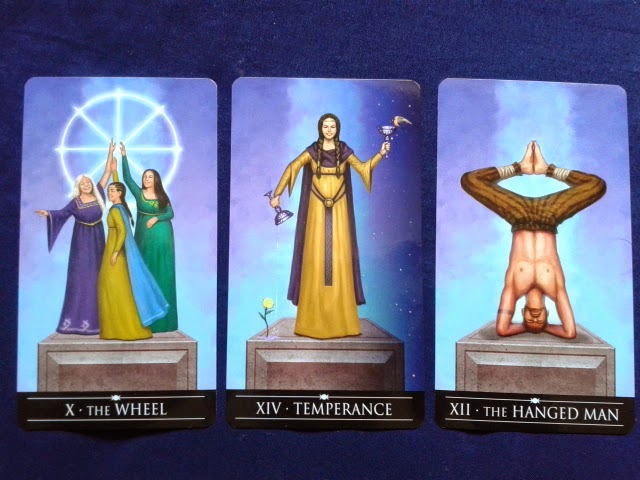
Here are a few of the Majors that are not my favorite. Maybe I'm being a little nit-picky, but there's a lot of smiling going on in this deck, and most of the smiling feels a bit out of context. This Wheel shows three very happy looking women - Maiden, Mother, Crone - touching an ethereal wagon wheel. Their expressions look joyous, which is not necessarily an emotion I tend to associate with this card. Temperance shows a grinning young lady rather stiffly holding two cups - one pouring its contents down over a flower, and the other providing sustenance for a bird. Why is she so...happy?? Serene, I could understand, but what's with the toothy grin? And the Hanged Man is not hanging at all, but is in a headstand yoga pose (looking rather like he's sunning his nether regions). Well, I get that, and I appreciate that the focus on the willingness to change perspective is very evident, but I just don't really like it that much. Maybe it's the striped pants.


There is a similar element in this selection of Minors that I feel rather "meh" about, in that these 5s (which are meant to reflect conflict/challenge/energetic instability) show rather...happy....looking people. The 5 of Wands crew appears to be having a pleasant talking circle, while the cats battle it out at their feet. The man and woman in the 5 of Swords are playing some sort of game in the sand, and from the looks on their faces it's apparent that they're both enjoying it quite a bit. I understand that the focus here is on how we can turn conflict into compromise, we can hear each other out, we can choose to support each other rather than becoming wrapped up in winning or losing. But I think there is value in showing challenge, and I would prefer to see that. Then we have the 9 of Pentacles.  I like the idea of honoring silence, of enjoying the peaceful liminal space between the rich harvest and the coming of winter. But this card left me feeling a bit confused... a well-manicured blonde woman is shushing me, while a random pentacle floats behind her, stuck to her robe with strands from a spider's web. At any rate, I can work with it!

A Reading

I decided to draw a card, asking "What do I need to know about working with this deck?" As I started to shuffle, the Queen of Chalices jumped out at me, assuring me that my intuition will get along just fine with this set of cards:


When I finished shuffling, I drew the 6 of Swords, inverted. This deck will take me on a valuable journey, but I must be willing to suspend my rational mind and allow the cards to tell me their own story. Alright, I'm game!


All in all I am happy to have this deck in my collection, and I look forward to exploring its depths, and learning what unique wisdom it has to share.