Showing posts with label Santería. Show all posts

Tuesday, August 9, 2016

Circles, Cycles, Dreams, and Runes

On Monday I thought I'd pull a pair of cards for the week from the Giants Tarot. The Queen of Cups (Ran) came flying out of the deck, and I drew the High Priestess (Angrboda) as her complement. What an interesting pair, I thought, regarding their close partnership: water, intuition, passivity, contemplation, wisdom, femininity, emotional intelligence.
This morning I decided to take the day off to spend with my kids, as tomorrow they all begin once again that spiral dance of the school cycle, with my son just embarking on his own as he takes his first steps into Kindergarten. So I was sitting at the kitchen table nursing my second cup of coffee and continuing my journey through Futhark (by Edred Thorsson, a.k.a. Stephen Flowers). I paused when my husband came to the table, and pulled out the Earthbound Oracle; he pulled a card, I pulled a card. I drew Luna, that perfect, pale circle. I thought how fitting it was to pull this moon after having drawn two very closely aligned Tarot cards for the week. More water, cycles, and emotional food for thought. 

I kept reading.

I read Thorsson's discussion of the cosmic void from which the runic system and its energies descend, about how Odin, Vili, and Ve gave form and structure to those energies in the creation of the multiverse. And as I flipped the page I saw a diagram of the futhark pattern of manifestation, a series of concentric circles expanding out from a central point, a core out of which the runes arrange themselves in linear patterns. As I examined the diagram it touched on a dream I had back in May, and I opened my journal to find the entry I had written about it.
My dream was not obviously runic. I had it at a time when I was struggling a bit with how to incorporate two different religious/spiritual traditions and cosmologies into my personal practice - could I integrate Santería and the Northern Tradition harmoniously? Would I, or should I, choose only one? In many ways I have come to understand that Santería has both brought me more fully to the Northern Tradition, and has helped me contextualize it. I understand Northern cosmology more intimately because of my understanding of Lucumí cosmology. I understand and relate to the deities as individual energies and unique personalities because of my relationships with the Orishas. I don't mix and match faiths - I believe in tradition, and value depth above breadth. Santería was not a religion I had sought out - it became a part of me through my cohabitation with the saints over a period of a decade or more, and via my husband. One day I realized that the saints were alive within me, a part of my family, guides, and protectors, and teachers, and friends. It doesn't get much more organic than that. This was the point at which I formally entered into the mystery religion by way of initiation, and has been, and continues to be, a source of great sustenance for me.

Through ancestral veneration and exploration I more fully began to explore the Northern Tradition as a way of connecting to my Scandinavian/Germanic forebears (I wrote about this in a previous post). And as I delved into the Eddas and the Northern cosmology, the runic system, I found so much richness and satiation. It grew and expanded in my heart, mind, and spirit, such that it became far deeper than simply "honoring history." And yet I found myself worrying about whether or not I could, or should, practice two religions at the same time. Was it right? Was it doable? Could I fully embrace both without sacrificing either? My intellect was struggling, but my heart told me that it was my own limited, "human" thinking that was raising a fuss over compartmentalization; my heart told me that there was no conflict here.

While my dream was not runic, per se, it mirrored this futhark pattern of manifestation. In my dream I felt the presence of Odin, and I could see what seemed like a picture of the cosmos, as if I were in outer space. Concentric circles of cloud-like material surrounded a central point, like the Earth, and the idea was that the image before me was showing how throughout time old gods and goddesses would slowly dissipate and new gods and goddesses would develop to take their places, but that ultimately they were all part of the same force. There was great comfort in that. These deities and entities exist both sequentially and simultaneously in time.
A rough depiction of my dream
I knew that I could, and would, continue to walk this path, and that I would learn how to "do both" through the process of living it out, as opposed to trying to intellectualize it all. At times I feel like Odin and Obatalá - all of the gods and goddesses and orishas - are friendly associates, conferring with each other, working together, supporting one another in the pursuit of the same ultimate end-goals. I have always felt that Elegua, my best friend, held my hand, and opened the door for me to explore this ancestral history. I have at times sensed that Odin is happy for me to "make saint," and supports me in the endeavor. When I think about it, it makes sense - Odin is the ultimate explorer. He would not impose limitations, rather he would promote my exposure to all of the good that the universe has to offer, no matter its form.

In the end, the universe, the experience of "being," is so dynamic. Insofar as our own progress is concerned, we are often our own worst enemies, placing barriers where none exist, projecting our own limitations onto divine forces, creating rules of engagement that are ultimately fabrications of our own attempt at understanding the Great Mystery (or putting that mystery in a tidy box)*. As a human, I acknowledge that I don't know much at all, and that I do fear and worry from time to time. But when all is said and done, I am open to receiving that mystery, even when I can do nothing but simply accept it.


*I don't believe in picking and choosing the "favorable" parts of a religious tradition, and throwing out the rest, nor do I (generally speaking) support the practice of honoring a patchwork pantheon of various deities outside of the context of their history, culture, and original traditional framework. There is too much room for cultural appropriation there. I do, however, believe that there is far more flexibility in the spiritual world than humans tend to acknowledge or allow for.

Tuesday, December 29, 2015

Weaving Spirituality: Santería and the Northern Tradition

Ellen, from Greylady's Hearth, asked me some time ago to write about the ways in which I incorporate both Santería and the Northern Tradition into my spiritual/religious practice. It is at once a rather simple and complex topic; I don't necessarily combine them, but I do honor Norse/Germanic history and mythology as a part of ancestor veneration. And as I've pondered it over the past couple of weeks some salient areas of relationship between the two have risen up into my thoughts:
1) Both Santería and the Northern Tradition feature a variety of gods and goddesses/Orichas whom we learn about through our personal relationships with them, as well as through sacred stories or myths. In these stories they interact amongst themselves as well as with others, oftentimes showing quite human characteristics that serve to teach us about the world (and in fact some were human at one point or another). In Norse history these are the Poetic Edda and Prose Edda, as well as the Sagas to some extent. In Santería these are the patakís. A principal divergence here is that while the "pantheon" in Santería includes the presence of a primary creator God, Olodumare, no such equivalent exists in the Northern Tradition. (Santería is a monotheistic faith, whereas the Northern Tradition is considered polytheistic. The Orichas are somewhat similar to saints, which lent themselves to being syncretized with Catholicism during slave times in the New World).

2) Both Santería and the Northern Tradition feature a divination style unique to the history of each. In Santería divination is most typically done via the caracoles (Merindilogún, cowrie shells - usually those of Elegua) by Santeros, or using the epuele or Opon Ifá (Table of Ifá) by Babalawos, priests of Orula (I'm sidestepping obi divination since it is essentially a yes/no system that, while extremely helpful and useful, lacks the complexity of the previous two). The heart of both the caracoles and Ifá lies in the Odu (which is too complex a subject to detail here). In the Northern Tradition the wisdom of the runes was granted to Odin after he sacrificed himself (to himself, as it were) for 9 days hanging upside down from the branches of Yggdrasil.
3) Both Santería and the Northern Tradition place heavy emphasis on ancestor veneration. In Santería, our family members who have passed on, previous generations we may never have had a chance to know, even spiritual ancestors (such as those of our god family) form our egun, those without whom we may not exist, those whose own life experiences may have sent vibrations down through our family's energetic ties that could well be influencing us today in ways we may not even be aware of. Our egun, our ancestors, are honored, recognized, petitioned for support and guidance. We offer them water, coffee, flowers, plates of food. We talk with them. We welcome them, invite them to be present for us in any way that they are able.

I honor my egun at my bóveda - my altar. Learning about the Northern Traditions (a term I most commonly use to refer to the Norse/Viking/Germanic pre-Christian spiritual beliefs and tales) is one way that I honor aspects of my biological lineage. While my physical ancestors are diverse (British Isles, southern Italy, Northern Africa, the Middle East, Northern Europe and Scandinavia, even South America) I have always been drawn to Viking history. Thus, it has become an aspect of personal study, it contributes to an extent to my spiritual ideology, and serves as an element of ancestor veneration, even within the context of Santeria.

*************************************************

I fondly recall listening to my aunt proudly discuss our North Frisian and Danish "Viking" history when I was a young adolescent. She and my uncle named their boat "Norddorf" after the town of my great-grandfather's birth on the island of Amrum in the North Sea. Amrum is one of the North Frisian islands located off the coast of Germany, near Denmark. He, along with his Danish wife, my great-grandmother Emilie, form the first generation of U.S. immigrants on my father's side.

As I started to learn more about ancient Norse mythology I was drawn even more deeply into the fold. I was born on a Wednesday, Odin's Day, and I was born near Yule, a time associated with the Wild Hunt. I found Odin fascinating - a shaman, a warrior, a seeker, a leader, a wanderer, a diviner, in some ways a loner.  Those were attributes that called to me. A couple of years ago I finally began to study the Elder Futhark runic system with more diligence and focus. On my husband's many jaunts to Sweden he has brought me back treasures such as a silver mjölnir pendant which I wear along with my elekes (sacred necklaces of the Orichas which are granted as part of one of the first initiations in the religion). In fact, in a sort of intercultural yin-yang, my husband also wears a mjölnir!

Santería is my religion, the set of traditions into which I am initiated through my god family. It is my heart; in important ways it forms the foundation from which I approach my life, and provides a framework within which I may come to understand (as much as any of us are truly able) my place in the universe. Honoring and learning about the Northern Tradition is one way in which I recognize my biological ancestry, and thus coexists harmoniously with my overall spiritual practice.
Interestingly, as I was writing this post I took a break, and as I was making some tea my husband came home and handed me a surprise package: a carved candle in the form of an elderly man, and a white and tan egg, also a candle. He said that the carved man reminded him of someone who could be my grandfather, and indeed when I saw it I thought of a European mariner. And the egg is connected to my Ángel de la Guarda, Obatalá. Beautiful synchronicities ;-)

Tuesday, September 8, 2015

Maferefun Yalorde!

Today is the feast day of Ochun, lady of the sweet waters, of love and honey and joy.
Artist: Hubert Escobar
Ochun is considered the youngest of the Orishas, and though she represents the beauty and sweetness of life, she is a source of profound strength and power. One of my favorite patakines (sacred stories) about Ochun tells about a time where there was a great drought on earth and everyone was suffering. Other Orishas had tried to reach Olodumare (God) to tell him what was going on, but were unsuccessful. Finally, Ochun climbed on the back of a peacock (one of her sacred symbols) and flew up through the sky, past the scorching sun, and to the realm of Olodumare. On the way, the heat of the sun had burned the feathers of the peacock, such that it no longer had the lovely, colorful plumage. This is said to be the first vulture. Ochun herself was also badly burnt, her beauty marred by fire. Olodumare realized that she had sacrificed her vanity for the well-being of the world, and he healed her, though her beauty was not restored. This highlights how Ochun's beauty is not solely physical - her strength, love, and beauty shine on the inside. Olodumare heard her plea, and allowed the rains to fall again on earth. Since then Ochun has been known as a messenger of God.

Ochun is dear to me. Aside from Elegua and my guardian Orisha, Obatalá, she was one of the first saints to step forward in my life as a guide, support, teacher, and wellspring of deep love and joy. On this day, her feast day, as we openly honor and praise her, I feel her abundant felicity in my heart, a special kind of lightness that I clearly sense is her sacred essence coursing through me. 

My son, Gabriel, is Ochun's son. While all of my children are loving and expressive in their own ways, Gabriel is by far the most demonstrative, both physically and verbally. He's a total romantic. He often says, "You know what?? I love you and I like you!" Every single morning when Lourdes wakes up and stumbles out into the living room, Gabriel lights up and greets her with an affectionate, "Good morning, sweety!!!" He hugs, he snuggles, he loves to be loved, and he adores sneaking into the bathroom to douse himself in my perfume, or his dad's cologne (another attribute of Ochun, ha!). It warms my heart in ways that cannot be expressed adequately in words. This morning he woke up and said, "I'm so happy today!" When he saw his father he said, "Dad, it's Ochun's day!" He picked out a freshly made cookie to offer her, and he helped me light some candles in our window. 

Maferefun Ochun, Yalorde, Yeye...todos los días.

Tuesday, September 1, 2015

(Re)Building Your Holy House with the Ancestors

"The ancestors are the real school of the living. They are the keepers of the very wisdom the people need to live by. The life energy of ancestors who have not yet been reborn is expressed in the life of nature, in trees, mountains, rivers and still water." -M. Somé

In Santería, being open to, working with, revering, the ancestors is a critical foundation of practice. The impact that previous generations of family have had on our lives – in both conscious and unconscious ways – and the influence of the family oversoul require us to be willing to delve into our personal and ancestral histories, facing both the good and the difficult. The process of working with ancestral spirits serves the purpose of helping us to address and purge the negative, to understand the humanity of our forebears, and to embrace the wisdom and sacred blessings that they offer us. Ancestor work can have wonderful benefits for everyone, regardless of the spiritual/religious path that is followed, and helps root our Selves to the earth, to connect us with a deep history that is part of who we are, whether we are aware of it or not. There is something sacred in that.

The other night I decided to pull a couple of cards on the topic of ancestor work:

1) In what way are my ancestors present for me? 3 of Pentacles
Prisma Visions/James Eads
These are the raw notes that I took about how this card made me feel:

Working with me to help build the foundation, base structure, of my life. Supporting me, giving advice/suggestions, then stepping back and watching how I implement them. My own personal team. Helping me find tools to work for what I want and need. Helping me to build my holy house.

That last line took me some time to actually get down on paper. It was floating through my head, and I wasn’t entirely sure what it meant, but I decided that I’d figure it out eventually, so I jotted it down.

Helping me to build my holy house.

A night or two later I was reading a book* and came across a section that compared the personal impact of Orisha worship to restoring an old home:

As you watch those old walls come down, envision your inner walls being knocked away. Close your eyes and feel the two-by-fours cracking apart within you. Watch as dirty windowpanes shatter – windows through which you might have once viewed the world clearly…Watch as workers toil, removing the house’s battered and broken parts, in order to restore its strength and beauty…Feel their jubilation along with their calluses and aching backs as they see it slowly rise before them, restored, reborn (pp. 128-29; Correal, 2003).”

As I read those words, the 3 of Pentacles with the image of the man laying bricks suddenly popped into my mind. My “holy house” is me. In this light, my ancestors work with me like the toiling workers renovating that old home, helping me to open up, break down, and rebuild into a stronger, healthier, happier, more balanced human being. That is what it’s all about.

2) How can I best take advantage of their wisdom and guidance? Hanged Man
Prisma Visions/James Eads
Again, my rough notes are as follows:

Releasing a hold on/sacrificing the ego; making time in my schedule to talk to them. Be willing to allow time for life to develop – not being quick to judge. Letting go of control and trusting them. Open up to insight. 

There is a lot to be said for learning to surrender; to get out of your head, to view your experiences from new vantage points. It has become almost cliché to say, in regards to the Hanged Man, that one must be open to “seeing things from a new perspective.” The reality is that it’s true. When you climb a tree, your entire back yard transforms; you see things you never did, or never could, before. I remember riding a Ferris wheel at a community festival down the street from our house a couple of years back. Once we reached the ride’s apex we could see lakes that we never knew were there, and even the tips of the downtown buildings were visible, driving home the proximity of important places in our environment. But those instances are exterior; we literally see things from a new perspective because our physical bodies are lifted into the sky, or hung upside down. It’s more work to be open to new angles of thought from the inside. But the analogy is potent and clear.

It’s amazing just how driven we are to do what we want to do, or not do what we aren’t in the mood to do. In a way, like with Lent, there is a certain sacrifice in not giving in to our impulses, though in another way it is also about fundamental self-control, focus; our commitment to a practice lies to some degree in the ability to remember our truest, deepest desires, our most heart-centered goals.

I say all of that because in our great rush, and our daily distractions, it’s easy to simply not take the time to sit at the ancestor altar and talk to them. Or just breathe for a few moments. To take a few seconds to call to mind your grandfather, or the name of your great-grandmother, or those nameless forebears that stream back into infinity whose essence you hold in your very cellular make-up. To hold them – even just the awareness of their existence - in your heart and mind briefly, and open yourself to their presence. So then, we sacrifice – “make sacred” – our offering of time, laying our ego out on the table because we know that in some way the benefits and blessings of that surrender might someday, stone by stone, make us whole again.
Prisma Visions/James Eads

*Finding Soul on the Path of Orisa/Crossing Press/T.M. Correal

Sunday, August 9, 2015

Religion As Spiritual Sustenance

I was raised with elements of Christianity, paganism, and indigenous ideology. While I was christened in the UCC as a baby, my mother was always searching for "the right fit." She was born into a Catholic family and celebrated her First Communion in the streets of southern Italy, wrapped in a white, lacy gown that hugged her small form. She always described the Catholicism of her childhood as "pagan" because while everyone loved the Pope, people practiced their faith in their own ways, often incorporating aspects of folk magic, such as using cornicellos to ward off the evil eye.
Cornicello and sign of the horns. Photo Credit: CRWR
When I was a girl I recall experimenting, alongside my mother, the worship practices of the Unitarians and Episcopalians. I remember attending a sacred circle with her at a retreat and educational facility tucked away in the Michigan forest, called Circle Pines, where I had my first taste of the power of meditative group trance. In my teen years my mother began to recognize the Celtic Wheel of the Year, and I remember becoming very familiar with Beltane and Samhain, and reveling in the creation of the ancestral altar.

In my early 20s I sat through a sweat lodge ceremony with my Ojibway boyfriend and other members of the local native community. My indigenous Costa Rican college professor was there, and in the evening while everyone was enjoying a communal meal, I helped his Anishnaabe wife bring the spirit plate outside and set it at the foot of a towering oak tree.
Sweat lodge/Walt Hubis
Throughout my life I always spent endless hours alone in the woods, absorbing the breeze, the river water, the movements of the deer, fox, and rabbits, picking raspberries and letting myself fly with the soul of the wild. All of these things impacted me in important ways. I grew up appreciating all faiths, and finding deep value in the uniqueness they each had to offer, and the similar qualities they shared.

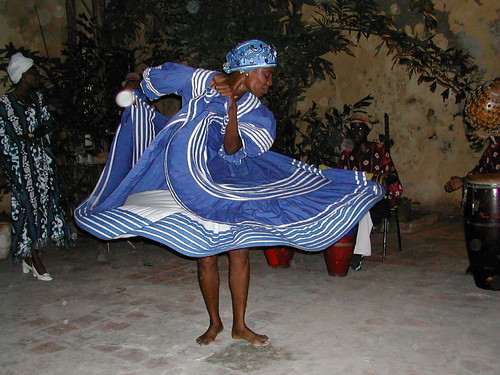
Still, I had never found a "seat for my soul" until after marrying my husband who had been raised with Santería in Santos Suarez, Havana, Cuba. After many years of living with the Orishas in our home, I one day realized they had become my dear family and my friends. My journey in Santería and Ifá had begun even before I'd become conscious of it, and has continued through the years to feed me in rich and indescribably wonderful ways as I've experienced initiations, delved deeply into the Yoruba perspective and cosmology, and grown in community with my family and ilé.  In the end, my religious practice was not something I sought out, but something that found me instead.
Yemaya dancer/James Emery
But I know that not everyone has positive experiences with religion and religious structure. I know that many have difficult memories of organized faith communities, and who prefer the freedom of expression that an unrestricted spiritual ideology offers. I've even found seekers who discover the beauty of the Orishas, but reject the ritual traditions that form the historical, ancestral, religious, and ceremonial context in which they are meant to be understood, explored, and experienced.

It is true that religion devoid of spirituality can be a dangerous entity, and in my experience it is the union of the two that create what for me is a deeply satisfying whole. And while many are content and well-served with spirituality devoid of religion, I do find that many "spiritual-not-religious" people develop practices that provide them some sort of structure, whether it be pulling Tarot cards for guidance, maintaining an altar, or honoring the turn of the seasons (and in fact these are all aspects of my own spiritual practice as well).

There is a subsection of people in the "esoteric" community (and in many communities, I suspect) that are very opposed to what they perceive as a rigid and authoritarian religious hierarchy that disempowers individuals. I wanted to explore this further, as there are people (like me) that have had a very different experience with religion. I decided to pull some cards:

"What represents religion at its worst - the aspects that drive people away?" The 5 of Swords almost immediately flew out of the deck.

Prisma Visions Tarot/James Eads
Interestingly this is often called the "bully card," and I'd say that "bullying" is an apt term to use to describe the negative experiences that some have had with organized religion. The 5 of Swords says, "it's my way or the highway," and represents the impulse to dominate others. In the religious context this can be the move to monopolize belief systems, to control the behavior of others (often via fear), and symbolizes the dogmatic systems used to beat out those who are deemed "less than."

What I like in this picture is the one figure watching the butterfly as it flies away from the fight as if wondering, "Could there be another way?" Divinity is out there swirling above their heads but they're so wrapped up in their victor-less battle for "right" over "wrong" that they don't even seem to notice.

This way of thinking ("my way is the only way", "if you don't act right you're going to pay") is a sickness of many, if not all, religious practices that have stepped away from spiritual creeds and become dominated by ego and baser instincts. However it doesn't mean that the religion itself has no value, rather that some of the people running the show have lost their way. So I ask....

"At best, what does religion offer?" I pulled the Hierophant, and the 2 of Wands flipped out as well.

Prisma Visions Tarot/James Eads
I find this to be a very fitting duo. The 2 of Wands is about choice, personal power and growth, and a search for the right path. We don't practice a faith because it is forced upon us (that defeats the essence of "faith," really). We practice it, learn it, live it and breathe it, we struggle with it and we love it, because we have made the choice to do so, and because it empowers us rather than disempowering us.

The Hierophant at first glance seems kind of funny: religion at its best is... religion? But no. Religion at its best is tradition. In the Handbook of Yoruba Religious Concepts (1994), Baba Ifa Karade writes: "Religion, as a custom of worship, is not man's purpose, but only a means to an end while the end itself is iwa-pele (balanced, gentle character). The fundamental reality in respect to the divinity of self and the heavenly forces is that of pure and enlightened character development" (pg. 23).

Religion isn't the purpose, it's simply a path, a means to improve the self and develop strong character with integrity. There are many roads that lead to the same goal, like there are stars in the sky. Nowadays most people have the opportunity to discover a faith practice that resonates with them - or to choose none at all.

I find my religion to be a great source of spiritual sustenance and wisdom, and the traditions are meaningful and sacred to me. Incidentally, while there are certain ways of conducting ritual and ceremony that should be followed (and even this will vary from house to house), there is generally a lot of flexibility and free will within the structure of the religion. Most often we receive advice or recommendations as opposed to mandates. This allows for a great deal of personal freedom and development. Even if someone were to unknowingly commit a "transgression" it's seen as a learning opportunity. There is a saying, "La inocencia se perdona" ("innocence is forgiven").

I am deeply fed by my relationship with the Orishas. They are not abstract concepts, or interesting-sounding entities; they are my father, my mother, my Warriors, my best friend, my teachers, my allies, my family. As I grow in my practice and knowledge, my relationship with them, with God, with my ancestors, and with myself, continues to deepen and blossom in wondrous, fulfilling, and beautiful ways. That, to me, is what it's all about.

"Only when you allow religion to be more than a book of rules or a means to get power can you internalize the fundamental truth about Creation: that our world overflows with the Sacred."
(pg. 24, Tobe Melora Correal; Finding Soul on the Path of Orisa, 2003).

Sunday, July 19, 2015

When Spirit Moves in Children


On this sunny Sunday morning I want to very briefly illustrate in pictures the beauty of spirit moving in children. There is nothing more touching than seeing how kids experience spirituality and religion, from their own perspective. Yesterday two things happened that really moved me. In the morning, I was sitting in the living room when my young son, Gabriel, came and said that he wanted to give his silver toy car to his Elegua. I told him that I thought it was a lovely idea, and I helped him balance it on his shelf.
Later in the evening my 8 year old daughter was working on crafts at the kitchen table. We've been working on rearranging her room, and part of that process has prompted her to organize her copious art supplies. When I walked into her room after her craft session, I realized that she had created her own little altar to her guardian orisha by placing a circle of shells around an image of Yemaya that she had cut out of a larger piece of paper.

These are seemingly "little" actions that in reality are hugely significant. They are the pure impulse of children to connect in a physical way with spirituality, an early, innocent, beautiful demonstration of spiritual practice. I have nothing else to say but: aché!

Tuesday, March 10, 2015

Triumph of Life Tarot Project

Andrew Kyle McGregor, owner of the Hermit's Lamp shop in Toronto, Canada, has spearheaded a project called "Triumph of Life Tarot." The aim of the project is to bring together 78 artists to create and donate art for the cards, and eventually to sell the deck and donate the proceeds to cancer research foundations.

Most, if not all, of the participants have been touched by cancer in some way, directly or indirectly. I decided to participate, as cancer has certainly touched my family (my step-father is recovering from prostate cancer, one of my aunts suffered from breast cancer, my grandmother had uterine cancer, and my husband's brother and father both died of aggressive lung cancer). It's a destructive disease that impacts far too many people in our world. Below is the explanation of my process of creating my card for the deck. If you want to keep up with the development of this project there is a Facebook group, and as things come to fruition and are available for purchase I'll also post updates here!

6 of Disks - Triumph of Life Tarot
O. Destrades
 
This is what I've created for the 6 of Disks, acrylic on canvas. First I will discuss color scheme, and to some extent the symbols, and then I'll discuss my thoughts/process:

The 6 of Disks is associated with the Moon exalted in Taurus. Both the Moon and Taurus are also associated with color scales (Moon - blues and silvers; Taurus - red/orange, brown, indigo) so I've represented these scales throughout the image. Taurus colors are noted in the candle and the color of the woman's skin (the earthy, material elements), and the Moon in the blue and silvery qualities in the sky and moon itself.

In Thoth the keyword for this card is "Success" - manifesting things on the material plane. In RWS this is a card of reciprocity, give and take, receiving assistance, guidance, generosity.

In this image a woman sits next to an ancestral altar - a table covered with a white cloth, bearing a lit candle. She looks up at the moon in a deep blue sky. 6 comet-like rays descend toward her. In my spiritual/religious practice, ancestor-veneration is integral. Our ancestors and loved ones that pass on don't remain in the past; they are often here with us in the present. We welcome them into our lives, request their help and guidance, and honor them with physical offerings of candles, glasses of water, and even foods and drinks that they enjoyed in life. Even though we lose physical touch with our loved ones when they pass, they are always available to help support us and aid us in our physical lives, whether via the feeling of companionship, the sense of being grounded in family or spiritual heritage, or even through mundane-yet-important experiences such as looking for work opportunities. We request their help and open ourselves up to receive it.

In this image the woman is alone, but surrounded in a golden glow representative of an ethereal embrace. She is aware of her ancestors, and they are aware of her. She's looking for a connection, her altar candle is burning, and all she has to do is ask. These comet-like rays fall upon her, representing those sparks of insight, gentle nudges, whispers from our departed loved ones as they support us and point us in the right direction on our earthly path.

I asked my brother-in-law Manuel, who died of lung cancer, to give me my card for this project. Mañe (short for Manuel) was diagnosed with aggressive cancer and died before he was able to leave Cuba and reunite with us in the USA. It was one of the biggest blows to my husband (and to Mañe) because they were like soul mates. Mañe is still a part of our lives. We talk to him, honor his memory, ask him for guidance and assistance and clarity, request help with centering ourselves on our paths in order to achieve success in our lives.

One story I can tell: After a year of asking for help conceiving our first child together (my husband was hoping for a girl), Mañe came in a dream and handed my husband a baby girl. The next day I took a pregnancy test and found I was indeed pregnant, and when all was said and done, it was a girl. The relationship that we have with Mañe felt like the perfect example of the energy of the 6 of Disks united with the questions posed by this project.

Our give-and-take crosses paths at the ancestral altar, and positively impacts the physical manifestation of success in our lives.

Saturday, June 21, 2014

Litha Blog Hop: Joy and Shadows


It's somehow ironic that, being the wrangler for this particular hop (which entails choosing the theme), I would experience writer's block, but that's just what happened between Beltane and Litha. I knew I wanted the focus to be "joy" because we spend so much time focused on what we can improve, or what needs tweaking, and not nearly enough time really basking in the glory of the joy that threads through our lives (at least that's how it often seems!). I'm a joy-person (not THE Joy Person - that's Arwen Lynch Poe!) and this is Litha, The Sun Celebration, so it all seemed very fitting!

New Orleans Voodoo Tarot
The divine light and joy within us!

So writer's block had me down, and then I found myself at the public library one evening with the three Joys of my life - my children!  As the little ones were climbing and arguing their way through the aisles with me, I happened across the Tarot for Life book by Paul Quinn, which I'd never seen before - neither at the library nor any other place that sells or rents books - (and after looking at its positive reviews on Amazon I realize I'm a late-comer to that game, and that it's completely crazy that I'm so in-the-dark) so I snatched it off the shelf. After settling the kids in the children's section with books and blocks and crayons, I myself settled down to give the book a cursory sifting. It took about 1.3 seconds for me to realize I'd found a wonderful source of Tarot wisdom, and one of the aspects of the book that most attracted me was that it covered the "shadow" aspect of cards in addition to the upright and reversed meanings. It's actually brilliant, and it resonated with my own reading experience quite potently. I've written before about cards in readings, where their upright orientation belies their true essence, and though I hadn't given it a title before, "shadow" aspects were indeed what I was encountering.

Llewellyn Publications
I happened to flip to the entry for the Sun card, and suddenly bells began to go off in my head - the shadow of the Sun! This was something I'd pondered for probably close to a year, after having calculated my Tarot birth card. I'd found that my personality card was the Wheel, my soul card was the Magician, and my Shadow card was nothing other than…the Sun! The first two made complete sense to me, but the Sun as my Shadow? I read and read and researched and thought and analyzed and considered, and nothing seemed to click in terms of what the Sun as my Shadow really meant for me.

Did it mean that joy or success were difficult for me to achieve, or that I'd spend my life always working on improving those things? Not really…..

Was it that my natural happiness wasn't accepted by my community (per Jung) leading me to try to diminish my own capacity for joy? No….

As I was flipping the pages of Tarot for Life things started to fall into place, like pieces of a puzzle. I've always been drawn to happiness like a moth to a flame, in order (perhaps) to create an environment that reflected my inner world. As a result I stayed as far from sadness as I could manage. This wasn't a conscious decision, but a visceral reaction.

I remember that I never liked melancholy music. One important memory I have from childhood is that my older sister would request that my mom sing her the song "Clementine" before she would go to bed. I hated it. I would plug my ears and bury my head in the pillow in order to avoid hearing it. I thought it was such a sad song (a miner lost his daughter when she fell into the sea and drowned!!), and I hated feeling sad. As I grew up that never really changed. I always preferred happy, vibrant music (for the most part - incidentally I've always been a big Blues fan!), I avoided any movies that highlighted pain and suffering (for the most part! - I did actually choose to watch Schindler's List because the Holocaust is something we should never forget). Sorrow was an extremely difficult emotion for me to process.

Zingdoodle Lenormand by Rootweaver

Don't get me wrong, I don't - and didn't - see the world through rose-colored glasses, nor did I shy away from difficult truths, or the bittersweetness that sometimes comes from living. Looking back it occurs to me that much of that connects with being empathic, and not knowing how not to absorb others' emotions as my own.  It makes sense then that I would have cringed at hearing Clementine - I was brought into the story, and felt the miner's pain, and the terrible sorrow of death (as funny as that may sound, as it's a children's song!). I've always felt a brilliant, joyful light shining from within me, and I wanted to just glow all the time, the full expression of my soul. And since life isn't happiness and light all of the time, my Shadow has truly been learning to face the pain and darkness that shows up from time to time along the way, and coming to understand through experience that while I still prefer being surrounded in positivity (who doesn't?), those painful times in fact provide valuable opportunities to grow, to understand myself (and others) better, and to become, ultimately, a more balanced human being. Additionally, as an empath a vital lesson is also to learn how to be supportive of others while learning how not to internalize their pain.

Ochun - Joy and Love
Image by Black Oshun Eternal

So what better time for this light of understanding to hit me than three days prior to the Litha Blog Hop, a time of Sun and Joy, a day of celebrating our fires before the gradual descent into the elongating shadows of Autumn….

To conclude, I want to bring this post back to the simple topic, so I will include a list of what brings me great joy:

-My children (as previously mentioned)
-My husband (I couldn't ask for a more supportive partner)
-Divination (as an extension of my sense of purpose and Will)
-My Joy (because it's simply joyful feeling an abundance of joy, and I'm grateful for it)
-My spiritual practices (with all the surprises, challenges, and stunning, awe-filled moments)

Go forth and be joyful, and build your Litha fires brightly!


Friday, March 14, 2014

Family Lines: Divination and Spirit

My mother is a Tarot reader. She is very intuitive and clairvoyant, and while she doesn't read professionally, she's always read for family and friends. Listening to her give readings with the Mythic Tarot when I was a kid is a lovely memory for me (I blogged a bit about that here). I had a good laugh the other day upon reading one of her Facebook status updates that went something like this: "I was really worried about my lost cell phone so while I was at the salon getting my hair done I did a Tarot reading. The cards told me to stop worrying about it because it would turn up. So I did, and it did!" The image of her sitting in a hair dresser's booth doing a reading about her lost phone was priceless. (And I'm really curious as to what her hair dresser thought!!).

But as I was thinking (and laughing) about this incident, the value and beauty of having this connection with my mother was not lost on me. My mother's family is predominantly from Calabria, Italy, and she grew up in southern Italy, splitting her time between Naples and Palermo. I remember that she used to describe southern Italian Catholicism as "pagan Catholicism," which always had an excitingly subversive feel to it.  She rejected the sense of male dominance in the Catholic church, but always held a deep affinity for Mary, and she has an entire wall of her kitchen dedicated to images of the Virgin and Child. Really, this "pagan Catholicism" was just syncretism, where an older religion or spirituality has been woven into the dominant belief and practice of the region. Common people never stopped believing in things like the evil eye, or seeking remedies for it. During one of my mother's visits home she brought me back a cornicello - a small red horn used to ward off the malocchio, which is a common talisman.

Cornicello

It was also my mother who introduced me to Tarot and oracles as a kid. It wasn't a formal introduction, it was just "there." She would read for me on occasion, or for friends, or sometimes other family members. Her cards always felt like a great mystery to me, and in my younger days I stuck to learning her animal oracle deck, which I adored. Tarot study, for me, would come later.

One of my most powerful memories with my mother (in terms of spirituality) was the night she took me to a ceremony when I was maybe 13 or 14. It was held at a social justice and environmentalism center outside of the city where we lived, deep in the heart of a forest. I honestly can't say I know what the ceremony was about or what the purpose was. What I do remember was being amazed at the powerful energy that united all of the people in the circle. At one point we were all chanting, and we started out very loudly, and at some point we all naturally started chanting more and more softly, until at the exact same moment we all stopped. It was about at that moment that I snapped "awake" and realized that I had been in some sort of altered consciousness with everyone else. I was in awe at how everyone seemed to be so connected, and it was all non-verbal. Later we all sat and ate together in potluck style, and I remember telling someone about a strange and striking daytime vision I'd had, and he was the first person not to look at me like I was a little crazy.*

I grew up with the powerful, embracing spiritual openness of my mother (who also was involved in aspects of feminism and the Goddess movement), and also very entwined with indigenous American culture and spiritual practice (and the rusty, dusty, bittersweet reality of reservation life) which all impacted my development. I met my husband when I was 24 years old, and one of our instant connections was some sort of spiritual resonance. I remember the first native dance I brought him to, and how moved he was by the drumming. He said it felt that although he was sitting still, something inside of him was dancing. I guess that sealed it!

My husband was raised in Cuba and Santería was the spiritual practice he knew. His grandmother was a seer of sorts, a card reader who spoke frequently with "her spirits." When Jorge and I moved in together our respective alters sat side by side, a mix of Elegua's stone and shell face, metal tools of the Warriors, offerings, stones, abalone, sage and sweetgrass.

371341236_db37063bec
Dancer of Yemaya

Through my husband I came to know aspects of the orishas, and have introduced them to our own children. Today Santería is a home for me, and I have great love and respect for the orishas, who feel like my family, and the practices associated with this religion and spirituality. Ten years after we first moved in together Lukumí forms a central part of our household, and our Warriors sit side by side behind our front door, while my stones and sweetgrass decorate my boveda, in another part of the house. My husband is leaving in a few days for one of his periodic visits to see his mother, and he's made a special mission for himself - to find and bring back his grandmother's cards for me. I was touched and honored.

Two or three different branches, or lineages, of religion, spirituality and practice have converged in my household, and as the years pass, the union, and the nourishment it offers, becomes so much deeper. I'm happy to have this legacy to pass on to our children.


*The vision occurred when I was walking home from middle school with two friends. We came to a point in the walk where one friend would start heading off in another direction, so they stopped to chat for a minute. During their talk, I sat down on the grass by the curb to wait. I felt something strange in my pant leg, so I reached up and pulled out a hand full of earth worms, all cut up and writhing around. I was horrified and threw the handful down in the dead grass and jumped up and shouted to my friends what had happened. I thought they'd be horrified too, but the big shock came when they looked at me like I was insane - I wasn't expecting that. I looked down and there were no worms anywhere to be found. Then I realized it hadn't happened at all, at least in real life. I walked home in a daze, and wondered for a long time what the hell that was all about! Now I understand that earthworms are about the power of regeneration and growth and healing, which was an apt message for me at that time because my parents were going through a divorce. There may be more to it, but at any rate, it would have been wonderful to have understood that at the time.

Friday, February 28, 2014

Deck Review: New Orleans Voodoo Tarot

I recently became aware of this deck (by Louis Martinie, Sallie Ann Glassman/Destiny Books) through a Facebook forum post that I read, and I was intrigued - I've considered some Orishas and Lucumi decks in the past, but I wasn't impressed with any I saw. This was a Voodoo deck, but there are many parallels between Voodoo and Santería, so I wanted to learn more. Upon doing some light investigation I found that the deck art was created by a Mambo (priestess) of New Orleans-style Voodoo, and she had in fact incorporated Santería into the deck! While many reviews I read were positive, I saw some potent criticisms as well.  Since I was so pulled in by this deck, I decided to find out for myself what it was all about….

This deck has 22 Majors and 56 Minors for a complete 78 card deck. The Majors embrace aspects of Voodoo that pair closely with traditionally understood meanings of each card. For example the Fool card is called the World Egg, and represents the beginning of creation, unformed energy full of promise. I adore this representation of Fool energy, and it works very well with its "zero" numbering. The Wheel of Fortune is called the "Market" and depicts exactly what you would imagine - an outdoor market of vendors meant to symbolize the ebb and flow of the resources on which our lives depend. A creature that looks a bit like Anubis stands in the center of the circle of tables, arms outstretched. The image is shown from almost a bird's-eye view, and the vendors are arranged in a circle, which maintains the sense of cyclical movement. One of my favorites is XV Courir le Mardi Gras. This card carries energy of Pan and the Wild Hunt, and depicts the Mardi Gras Run held in southwestern Louisiana on Fat Tuesday.

New Orleans Voodoo Tarot
Martinie/Glassman

The Minors are separated into four suits, and three bear the names of different branches of Voodoo, while the fourth represents Santería - a neighboring religion stemming primarily from Cuba (whereas Caribbean Voodoo developed in Haiti). Rada is Air, Congo is Water, Petro is Fire, and Santería is Earth. For the three Voodoo branches, Kings are the "Houngans" (priests), Queens are "Mambos" (priestesses), Princes are called "la Place" (masters of ceremonies that serve the houngans and mambos), and Princesses are "Hounsi" (female ceremonial servers). For the suit of Santería, the King is "Santero" (initiated male), the Queen is "Santera"(initiated female), the Prince is "Oriaté" (priest in Lucumi prayers) and the Princess is "Yaguó" (initiate). Many cards carry meanings close to the traditional, though some are significantly different. For instance 1 Congo (Ace of Cups) is about the flow of pure emotion and happiness. On the other hand 9 Rada (9 of Swords) speaks of messengers between earth and spirit, and even can signify house moves.

New Orleans Voodoo Tarot
Martinie/Glassman

Even for people who practice Santería or Voodoo, or are interested in African-diasporic religions and spiritual systems, this deck doesn't satisfy everyone's tastes. Some critics have denounced the inclusion of Santería in this deck (I however appreciate it). Yes, there are significant differences between Voodoo and Santería, however I don't feel it takes away from Voodoo, and it honors a closely-related spiritual system that has experienced a very similar history, creating what I consider to be a lovely complement. Other issues relate to some small but important differences in the presentation of certain lwa (also called "loa" - the spirits of Voodoo), or orishas (the important spirits/saints in Santería). For example, Eleggua in Santería is typically understood to be a small boy. In this deck the book calls it a small girl. There is no explanation for this change, however I don't feel the image is difficult to work with - if I think of Eleggua as a boy (and I do), the picture on the card definitely can be seen as a boy.  Another issue is the depiction of Damballah Wedo, from Voodoo. One of the cards in the deck shows Damballah Wedo as a red snake, which seems to have upset some people due to the traditional and sacred association with the color white. (There are other cards in the deck that show this deity as a white snake). I wrote to a practicing Mambo to inquire about this issue after learning that she uses this particular deck regularly. She told me that this deviance was in part an artistic interpretation, and in part was due to the way in which spirits appear to people in different ways. She said that Damballah Wedo might appear to me as a green snake, and to my friend as a purple snake. That made sense to me, and satisfied my curiosity.

Lukumí is my religion and that of my husband, our children, friends, and extended family both in the United States and in Cuba. While I love this deck, I wanted my husband's opinion as well. After looking through the deck, he's also given it his seal of approval. He saw the child on the Eleggua card as male (I didn't tell him about the book description!). His only hang-up was the fact that the Olofi card shows the image of a pregnant woman, when this manifestation of God-on-Earth is often seen as male (there are some practitioners that see Olofi as female). I read the book entry and it says that Olofi's creation-energy was combined with Earth energy, leading to the use of the symbol of the pregnant woman. It did not say that Olofi was female or male, or that the image itself was supposed to be Olofi. So no matter how you conceive of Olofi, there is room for interpretation in this card.

New Orleans Voodoo Tarot
Martinie/Glassman

The artwork in this deck is beautiful, and looks to be perhaps color pencil or oil pastel, on excellent card stock. The energy reminds me somewhat of that of the Wildwood Tarot in that it carries a deep, shamanic feel that appeals to me and my spiritual worldview. In fact the only two decks I've worked with, to date, that have caused a tingling sensation in my crown chakra upon working with them have been these two (yes, cards are "just" ink on paper, but some decks reach into us more profoundly than others). The drawings are colorful, soft, flowing, textured and rich, and most cards maintain the right balance between simplicity and complexity of detail that help engage intuition.

So how does it read? Well, I've done one reading with it so far, and it was stunning. I found that I seemed to read almost exclusively using intuition, and that, in part, may be due to the different correspondences and energies of this deck. For instance, Yemayá was one of the cards. She is the orisha of the ocean and motherhood, and I know her as deeply connected to water, which is represented in the card image as well. But her suit, Santería, is connected to the earth element. I honestly didn't pay much attention to the number or element. Yemayá was the only thing that mattered, and she gave deep meaning to the reading I was doing.  Another card was the Hounsi of Congo (Page/Princess of Cups). The picture of a young person pouring water out of a vessel melded with the cards on either side, creating a sacred story. The traditional Page meaning provided insights, but the image itself and its connection with the others in the reading spoke loudest of all. The colors and images flowed together, and provided such depth of meaning - it was beautiful "conversation" of sorts.

This is a special deck for me, and one I look very forward to reading with, and further connecting with. For readers interested in or connected to shamanic practice, or African-diasporic spirituality, this deck is a valuable one to own and work with. As there are a few non-traditional elements to some of the depictions and representations, it would be beneficial for the reader to either already have an understanding of Voodoo and/or Santería, or be willing to study it in addition to careful review of the accompanying book (which is hefty and quite nice). There is great wisdom available here, just waiting to be tapped.