

Showing posts with label Northern Tradition. Show all posts
Showing posts with label Northern Tradition. Show all posts
Monday, May 1, 2017
SHEathenry Podcast: Conference of Heathen Women, Your Questions Answered
The 1st Conference of Heathen Women is taking place this July 28-30th in Asheville, North Carolina, and this past Saturday morning I had the chance to join a co-organizer, Hilary Wehrle, and host Alvilldr Infägra, to chat about the conference details - click here to listen!

Wednesday, March 15, 2017
Rune Study Post #1: Three Aettir
I have been facilitating a rune study "course" of sorts for a group of Heathen women, and have decided to post here as well in case the content is helpful for the broader community. The goal is to create discussion around the runes, to share knowledge and experience. In that light, please share your own relevant experience with runes for each post! I begin with a broad overview of the three aetts, and then continue on to discuss each rune in the Elder Futhark.
Rune Post #1: Three Aettir
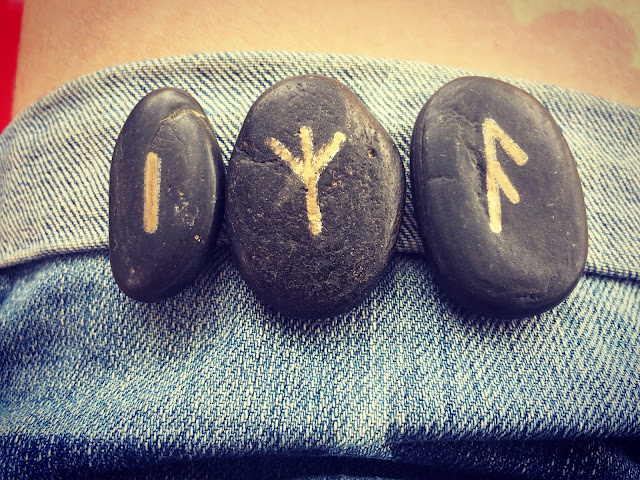
To start us off, I thought it would be helpful to take a step back and consider the entire runic alphabet and its structure. In the Elder Futhark, the 24 runes are divided into three families - aettir - of eight runes. Assigned to each family is a common title: the 1st is often called "Freyr/Freyja's aett," the 2nd "Heimdall's or Hagal's aett," and the 3rd "Tyr's aett." Each aett is considered to govern a particular process, and there is some variety in terms of definitions for each, including: creation/production (Aett 1); transformation/initiation/change (Aett 2); order/divinity (Aett 3). (Runic alphabets are referred to as "Futhark" due to the order of the first six runes in the 1st aett: fehu, uruz, thurisaz, ansuz, raidho, and kenaz).
For the sake of structure I'll be following the aettir when creating the rune posts, moving next to Fehu, and ending ultimately with Othala. (Incidentally, for those new to runes, dividing them into their respective families may help with learning and retention!)
Questions for consideration:
1) Do you recognize/find value in the attire?
2) Does your understanding of them differ from what is included in this post, and if so, in what ways?
3) How do you incorporate them into your practice?
4) If you don't use them, why don't you?
 |
| Image: ChaoseVIIn |
To start us off, I thought it would be helpful to take a step back and consider the entire runic alphabet and its structure. In the Elder Futhark, the 24 runes are divided into three families - aettir - of eight runes. Assigned to each family is a common title: the 1st is often called "Freyr/Freyja's aett," the 2nd "Heimdall's or Hagal's aett," and the 3rd "Tyr's aett." Each aett is considered to govern a particular process, and there is some variety in terms of definitions for each, including: creation/production (Aett 1); transformation/initiation/change (Aett 2); order/divinity (Aett 3). (Runic alphabets are referred to as "Futhark" due to the order of the first six runes in the 1st aett: fehu, uruz, thurisaz, ansuz, raidho, and kenaz).
For the sake of structure I'll be following the aettir when creating the rune posts, moving next to Fehu, and ending ultimately with Othala. (Incidentally, for those new to runes, dividing them into their respective families may help with learning and retention!)
Questions for consideration:
1) Do you recognize/find value in the attire?
2) Does your understanding of them differ from what is included in this post, and if so, in what ways?
3) How do you incorporate them into your practice?
4) If you don't use them, why don't you?
Friday, September 23, 2016
Tarot Blog Hop: Winter Finding
Welcome to the Autumn Equinox Tarot Blog Hop, hosted by Jay Cassels and Arwen Lynch Poe. The topic this season is "Foodie's Guide to the Tarot" (though for all intents and purposes posts may feature any oracle or divination tool!).
The Equinox is celebrated around the world, and goes by an array of names according to tradition, culture, or region. Among the practitioners of the Northern Tradition, some refer to this equinox as Winter Finding, a harvest time where special attention is paid to the Vanir gods and goddesses of abundance and fertility, such as Freyja, Freyr, Njörd, and Nerthus.
 |
| Das Germanische Götterorakel - Voenix |
Njörd is a god associated with wealth. He is also principally tied to the sea, and humankind's relationship with it: the winds, waves, the catch. Thus Njörd is connected to mariners, fishermen - any and all those whose living depends in some way upon the ocean.
The card featured here is from the Das Germanische Götterorakel (The Germanic Gods Oracle) by Voenix and Thomas Vömel. It is an 81-card oracle deck which represents the major deities, heroes, giants/jötunn, and overarching concepts in the Norse Eddas and Sagas. Here we see Njörd sitting on a coastline draped in seaweed, surrounded by gulls. An open chest of gold lies to his side, and a longship can be seen in the background. A keyword, "Reichtum," is listed on the card, which means "wealth."
The card featured here is from the Das Germanische Götterorakel (The Germanic Gods Oracle) by Voenix and Thomas Vömel. It is an 81-card oracle deck which represents the major deities, heroes, giants/jötunn, and overarching concepts in the Norse Eddas and Sagas. Here we see Njörd sitting on a coastline draped in seaweed, surrounded by gulls. An open chest of gold lies to his side, and a longship can be seen in the background. A keyword, "Reichtum," is listed on the card, which means "wealth."
I've often imagined some of my ancient North Frisian and Danish forebears - sea people, island folk - holding a special regard for this Norse deity. My great-grandfather left the island of Amrum as a young boy, and came to New York City with his family. Here they are, in the traditional dress of Amrum and Sylt (my great-grandfather is the boy at the lower left).

In the United States he met and married my great-grandmother, Emilie Hansen, from Ribe, Denmark. Ribe is the oldest town in Denmark, and one of the oldest towns in all of Scandinavia. It is located in southwest Jutland and borders the North Sea, not more than 100 kilometers from Amrum.
Gerret and Emilie's son, also named Gerret, was my grandfather, and of his three children, one of them - my aunt Lillian - dedicated her life to the U.S. Coast Guard, and for many years (until it sunk in harbor not too long ago) owned a boat she named "Norddorf," after Norddorf, Amrum. I have fond memories of family celebrations aboard that vessel. The "sea gene" continued to breathe life into the following generations.
 |
| My Grandfather, Gerret |
One of my earliest memories of my grandfather (who died of a heart attack while mowing the grass when I was barely two years old) is of sitting next to him at a cafe counter and ordering New England clam chowder. I was so young when he died that I can't be absolutely certain that this occurred, but I've had the memory since I can recall, and the recollection of my grandfather's clothing - a white t-shirt, blue jeans, a red baseball cap - has always been vivid.
Clam chowder is a fitting maritime meal, it's perfect for the cooling months of coming autumn, and it connects well with honoring Njörd at the Winter Finding, so I'll offer it here.

I am decidedly not the recipe sort so I'll do what I can to give accurate quantities...
New England Clam Chowder
- 4 large potatoes
- 1 onion or leek
- A 15 oz. can of corn (you can use fresh corn, or frozen, as well)
- Water (enough for boiling the potatoes)
- 1-2 cups of milk (whole milk is great, but you can also use a smaller amount of heavy cream)
- 1 small can of clams (go for fresh if you like!)
- A slice or two of bacon (optional, but worth it)
- Salt and pepper to taste
- Butter and/or olive oil
Now, as I said before, this is my attempt at quantifying a recipe that I usually just "eyeball." If you choose to go for it, don't be afraid to add more or less of any of these ingredients! And if you need precision, there are a lot of nice-looking recipes online that will do the trick (here is one).
 |
| Njörd altar space |
Enjoy the Equinox! Happy Mabon, and a Blessed Winter Finding to you all!
Please use the links at the top or bottom of this post to navigate to the other wonderful blogs in this circle.
Tuesday, August 9, 2016
Circles, Cycles, Dreams, and Runes
On Monday I thought I'd pull a pair of cards for the week from the Giants Tarot. The Queen of Cups (Ran) came flying out of the deck, and I drew the High Priestess (Angrboda) as her complement. What an interesting pair, I thought, regarding their close partnership: water, intuition, passivity, contemplation, wisdom, femininity, emotional intelligence.

I kept reading.
I read Thorsson's discussion of the cosmic void from which the runic system and its energies descend, about how Odin, Vili, and Ve gave form and structure to those energies in the creation of the multiverse. And as I flipped the page I saw a diagram of the futhark pattern of manifestation, a series of concentric circles expanding out from a central point, a core out of which the runes arrange themselves in linear patterns. As I examined the diagram it touched on a dream I had back in May, and I opened my journal to find the entry I had written about it.
 My dream was not obviously runic. I had it at a time when I was struggling a bit with how to incorporate two different religious/spiritual traditions and cosmologies into my personal practice - could I integrate Santería and the Northern Tradition harmoniously? Would I, or should I, choose only one? In many ways I have come to understand that Santería has both brought me more fully to the Northern Tradition, and has helped me contextualize it. I understand Northern cosmology more intimately because of my understanding of Lucumí cosmology. I understand and relate to the deities as individual energies and unique personalities because of my relationships with the Orishas. I don't mix and match faiths - I believe in tradition, and value depth above breadth. Santería was not a religion I had sought out - it became a part of me through my cohabitation with the saints over a period of a decade or more, and via my husband. One day I realized that the saints were alive within me, a part of my family, guides, and protectors, and teachers, and friends. It doesn't get much more organic than that. This was the point at which I formally entered into the mystery religion by way of initiation, and has been, and continues to be, a source of great sustenance for me.
Through ancestral veneration and exploration I more fully began to explore the Northern Tradition as a way of connecting to my Scandinavian/Germanic forebears (I wrote about this in a previous post). And as I delved into the Eddas and the Northern cosmology, the runic system, I found so much richness and satiation. It grew and expanded in my heart, mind, and spirit, such that it became far deeper than simply "honoring history." And yet I found myself worrying about whether or not I could, or should, practice two religions at the same time. Was it right? Was it doable? Could I fully embrace both without sacrificing either? My intellect was struggling, but my heart told me that it was my own limited, "human" thinking that was raising a fuss over compartmentalization; my heart told me that there was no conflict here.
While my dream was not runic, per se, it mirrored this futhark pattern of manifestation. In my dream I felt the presence of Odin, and I could see what seemed like a picture of the cosmos, as if I were in outer space. Concentric circles of cloud-like material surrounded a central point, like the Earth, and the idea was that the image before me was showing how throughout time old gods and goddesses would slowly dissipate and new gods and goddesses would develop to take their places, but that ultimately they were all part of the same force. There was great comfort in that. These deities and entities exist both sequentially and simultaneously in time.
I knew that I could, and would, continue to walk this path, and that I would learn how to "do both" through the process of living it out, as opposed to trying to intellectualize it all. At times I feel like Odin and Obatalá - all of the gods and goddesses and orishas - are friendly associates, conferring with each other, working together, supporting one another in the pursuit of the same ultimate end-goals. I have always felt that Elegua, my best friend, held my hand, and opened the door for me to explore this ancestral history. I have at times sensed that Odin is happy for me to "make saint," and supports me in the endeavor. When I think about it, it makes sense - Odin is the ultimate explorer. He would not impose limitations, rather he would promote my exposure to all of the good that the universe has to offer, no matter its form.
In the end, the universe, the experience of "being," is so dynamic. Insofar as our own progress is concerned, we are often our own worst enemies, placing barriers where none exist, projecting our own limitations onto divine forces, creating rules of engagement that are ultimately fabrications of our own attempt at understanding the Great Mystery (or putting that mystery in a tidy box)*. As a human, I acknowledge that I don't know much at all, and that I do fear and worry from time to time. But when all is said and done, I am open to receiving that mystery, even when I can do nothing but simply accept it.
*I don't believe in picking and choosing the "favorable" parts of a religious tradition, and throwing out the rest, nor do I (generally speaking) support the practice of honoring a patchwork pantheon of various deities outside of the context of their history, culture, and original traditional framework. There is too much room for cultural appropriation there. I do, however, believe that there is far more flexibility in the spiritual world than humans tend to acknowledge or allow for.

This morning I decided to take the day off to spend with my kids, as tomorrow they all begin once again that spiral dance of the school cycle, with my son just embarking on his own as he takes his first steps into Kindergarten. So I was sitting at the kitchen table nursing my second cup of coffee and continuing my journey through Futhark (by Edred Thorsson, a.k.a. Stephen Flowers). I paused when my husband came to the table, and pulled out the Earthbound Oracle; he pulled a card, I pulled a card. I drew Luna, that perfect, pale circle. I thought how fitting it was to pull this moon after having drawn two very closely aligned Tarot cards for the week. More water, cycles, and emotional food for thought.
I kept reading.
I read Thorsson's discussion of the cosmic void from which the runic system and its energies descend, about how Odin, Vili, and Ve gave form and structure to those energies in the creation of the multiverse. And as I flipped the page I saw a diagram of the futhark pattern of manifestation, a series of concentric circles expanding out from a central point, a core out of which the runes arrange themselves in linear patterns. As I examined the diagram it touched on a dream I had back in May, and I opened my journal to find the entry I had written about it.

Through ancestral veneration and exploration I more fully began to explore the Northern Tradition as a way of connecting to my Scandinavian/Germanic forebears (I wrote about this in a previous post). And as I delved into the Eddas and the Northern cosmology, the runic system, I found so much richness and satiation. It grew and expanded in my heart, mind, and spirit, such that it became far deeper than simply "honoring history." And yet I found myself worrying about whether or not I could, or should, practice two religions at the same time. Was it right? Was it doable? Could I fully embrace both without sacrificing either? My intellect was struggling, but my heart told me that it was my own limited, "human" thinking that was raising a fuss over compartmentalization; my heart told me that there was no conflict here.
While my dream was not runic, per se, it mirrored this futhark pattern of manifestation. In my dream I felt the presence of Odin, and I could see what seemed like a picture of the cosmos, as if I were in outer space. Concentric circles of cloud-like material surrounded a central point, like the Earth, and the idea was that the image before me was showing how throughout time old gods and goddesses would slowly dissipate and new gods and goddesses would develop to take their places, but that ultimately they were all part of the same force. There was great comfort in that. These deities and entities exist both sequentially and simultaneously in time.
 |
| A rough depiction of my dream |
In the end, the universe, the experience of "being," is so dynamic. Insofar as our own progress is concerned, we are often our own worst enemies, placing barriers where none exist, projecting our own limitations onto divine forces, creating rules of engagement that are ultimately fabrications of our own attempt at understanding the Great Mystery (or putting that mystery in a tidy box)*. As a human, I acknowledge that I don't know much at all, and that I do fear and worry from time to time. But when all is said and done, I am open to receiving that mystery, even when I can do nothing but simply accept it.
*I don't believe in picking and choosing the "favorable" parts of a religious tradition, and throwing out the rest, nor do I (generally speaking) support the practice of honoring a patchwork pantheon of various deities outside of the context of their history, culture, and original traditional framework. There is too much room for cultural appropriation there. I do, however, believe that there is far more flexibility in the spiritual world than humans tend to acknowledge or allow for.
Sunday, May 29, 2016
The Gods and Orishas: On Fate, Destiny, and Free Will
In the world of divination, the concept of fate, destiny, and free will is commonly discussed. Can we know the future? Is the future set in stone? Do we create our own future? How able are we to influence or change what is foreseen in the cards?
Opinions surrounding this topic vary from reader to reader. My own perspective is informed both by personal experience and by the sacred stories of the two religions that live in my heart: Ifá/Santería, and the Northern Tradition.
Destiny, in a general sense, is actually treated quite similarly within both religious frameworks, and my own experiences in divination reflect the complexities and mysteries present there.
To start, I’ll recap the story of Baldr’s death, as per the Poetic Edda:
Frigg, wife of Odin, is said to weave Wyrd (the Anglo-Saxon term for the Norse "Urd"), to be a seeress who seldom speaks of what she knows. When her son Baldr begins to have dreams of his own death, Odin travels to Hela and raises a dead witch in order to ask about it. He sees that the hall of Hela seems to be prepared to receive a new soul, and the witch confirms that they are waiting for Baldr. When Odin tells Frigg what he learned, she travels the worlds securing oaths from all things big and small that they will not cause Baldr’s death. Even though she is a seeress she still does what she can to prevent that tragedy from occurring. And yet she fails to secure an oath from mistletoe because she feels that it is too unassuming to be a real danger. Loki ends up using his notoriously deceptive means to learn of this. Later, when the Gods are playing a (really dumb) game to see how, when thrown at him, axes and arrows and swords fail to hurt Baldr, Loki gives a mistletoe dart to the blind God Hödur. Of course, when he throws it, Baldr falls dead. Even then Frigg sends another son to Hela to ask if there is any way to send Baldr back from the dead, and Hela says that if Frigg can prove that all beings in existence weep for Baldr, then she will release him back to the living. But there is one creature who refuses to cry: Loki (yet again) in disguise, and so Baldr stays put in Hela until after Ragnarök.
What this story shows is how inevitable some events are. Frigg is a seeress and that (of course) doesn’t stop her from doing all she can to try to prevent the death of her son. And despite all of her remarkable efforts, she loses him anyway. (There is a greater part of the story here of course, in that after the world ends, Baldr is released from Hela to bring light, peace, and love to the worlds once again. In that sense, Baldr’s death had a greater ultimate purpose for the well-being of the universe.)
In Wyrd, there are things that make up certain aspects of your destiny that you are bound to, that are unlikely to be greatly altered no matter what you might do. There are other aspects of your future that you live out according to your past: the consequences of your own actions, for good or for bad. And within Wyrd there is some room to improve your Wyrd, to influence your own path, whether that be through actions taken, or “simply” by an alteration of perspective. Interestingly, even the Gods, who we often assume to be omnipotent, are at the mercy of Wyrd (as we see with Baldr and Frigg).
Similarly, in Ifá, there is the concept of orí, which is one’s personal destiny, connection to divinity – in a sense it is the part of each person that is an orisha, that is holy. There is also Orí, a divine being that “owns” all orís. Like Wyrd, there are ways to live in “right relationship” with your own orí – to honor it, respect it, be open to it. And there are ways to influence your destiny via “being seen by Orula” – mirarse con Orula (a consultation with a babalawo) - whereby you may be instructed to tend to particular orishas, to your ancestors, to your orí, even to such things as the cleanliness of your home, in order to improve your overall environment, and invite better fortune. And like the Northern Tradition, one’s own orí trumps the influence and intercession of the orishas. There is a sacred story that tells of a man being dragged by the foot through a village by his own orí. He shouted for Chango to come help him. When Chango heard the man’s calls he came running, weapon in hand, prepared to fight in the man’s defense. But when Chango saw that it was the man’s own orí that had hold of him, he knew there was nothing he could do, and he went back home.
These stories and myths suggest that there are many layers to our future, to our destiny, to time as a whole (which is decidedly non-linear). Some aspects may not be significantly changeable, no matter what we do to influence them. Other aspects relate to our own free will – the choices we make in life, the attitudes with which we approach the circumstances that arise on our paths. Our ultimate freedom lies within our own perception. There is great power in that.
 In the Havamal, stanzas 55-56, Odin (who won the wisdom of the runes) says: “You should be only a little wise, never too wise. A wise man’s heart is seldom glad, if he’s truly wise; You should be only a little wise, never too wise. It’s best not to know your fate beforehand; you’ll live happier if you don’t.”*
I get that. Sometimes I just don’t want to know. I’ve had experiences where I have seen the future laid out the cards, and it’s not always a pleasant experience, though my experiences have differed according to the degree of event foreseen. Once I saw a minor money glitch in a line of Lenormand that helped me prevent an overdraft fee – that was ultimately a good thing, and I was able to change the outcome there (though it could be considered relatively inconsequential in the grand scheme of things). Another time (recently, in fact) I saw that a person that I was in the process of hiring would ultimately be denied at the last moment due to the school’s financial constraints. That was not at all what I wanted or hoped to happen, but seeing that gave me the opportunity to consider alternatives, and to get used to the idea, and by the time the official announcement was made I was feeling perfectly okay with it all. In that case I couldn’t change the outcome, but was able to receive it with a positive attitude. In yet another instance I saw the illness of a friend’s mother in the cards, about three months prior to it coming about. In that case I was troubled by it because there was really nothing that could be done, other than perhaps to prepare financially for a visit (in this case you couldn’t really even be “positive” about it, so it was unpleasant all the way around). Odin’s advice is sensible because, as in the case of Frigg, even the wisest of individuals can struggle at times to come to terms with unpleasant outcomes.
And as a card reader, my general sense of things is that many clients don’t know how to process undesired future possibilities (though that usually doesn’t prevent them from asking). These days, when reading for others, I tend to place the greatest emphasis on the past and the present, above all. Setting aside the idea of those future events that may be inevitable, there is space to positively influence our own lives, right now. By understanding the past, the root of our current dilemmas, and by looking at ways to embrace our own agency – our power over our present – we accept our responsibility to ourselves and our communities, we invite in growth and evolution, we honor our orí, and we work to improve our Wyrd.
My uncle said, over 20 years ago: “Attitude is everything.” It etched itself on my psyche and I’ve never forgotten it. Our greatest and truest sense of “free will” lies in our willingness to invite in new perspectives, to see the grace in challenging circumstances – to be positive even when it would be simpler to be otherwise. It is hard, at times, but therein lies our deepest power.
*Translation by Jackson Crawford, 2015.
Opinions surrounding this topic vary from reader to reader. My own perspective is informed both by personal experience and by the sacred stories of the two religions that live in my heart: Ifá/Santería, and the Northern Tradition.
Destiny, in a general sense, is actually treated quite similarly within both religious frameworks, and my own experiences in divination reflect the complexities and mysteries present there.
 |
| Elekes and mjölnir |
Frigg, wife of Odin, is said to weave Wyrd (the Anglo-Saxon term for the Norse "Urd"), to be a seeress who seldom speaks of what she knows. When her son Baldr begins to have dreams of his own death, Odin travels to Hela and raises a dead witch in order to ask about it. He sees that the hall of Hela seems to be prepared to receive a new soul, and the witch confirms that they are waiting for Baldr. When Odin tells Frigg what he learned, she travels the worlds securing oaths from all things big and small that they will not cause Baldr’s death. Even though she is a seeress she still does what she can to prevent that tragedy from occurring. And yet she fails to secure an oath from mistletoe because she feels that it is too unassuming to be a real danger. Loki ends up using his notoriously deceptive means to learn of this. Later, when the Gods are playing a (really dumb) game to see how, when thrown at him, axes and arrows and swords fail to hurt Baldr, Loki gives a mistletoe dart to the blind God Hödur. Of course, when he throws it, Baldr falls dead. Even then Frigg sends another son to Hela to ask if there is any way to send Baldr back from the dead, and Hela says that if Frigg can prove that all beings in existence weep for Baldr, then she will release him back to the living. But there is one creature who refuses to cry: Loki (yet again) in disguise, and so Baldr stays put in Hela until after Ragnarök.
What this story shows is how inevitable some events are. Frigg is a seeress and that (of course) doesn’t stop her from doing all she can to try to prevent the death of her son. And despite all of her remarkable efforts, she loses him anyway. (There is a greater part of the story here of course, in that after the world ends, Baldr is released from Hela to bring light, peace, and love to the worlds once again. In that sense, Baldr’s death had a greater ultimate purpose for the well-being of the universe.)
In Wyrd, there are things that make up certain aspects of your destiny that you are bound to, that are unlikely to be greatly altered no matter what you might do. There are other aspects of your future that you live out according to your past: the consequences of your own actions, for good or for bad. And within Wyrd there is some room to improve your Wyrd, to influence your own path, whether that be through actions taken, or “simply” by an alteration of perspective. Interestingly, even the Gods, who we often assume to be omnipotent, are at the mercy of Wyrd (as we see with Baldr and Frigg).
These stories and myths suggest that there are many layers to our future, to our destiny, to time as a whole (which is decidedly non-linear). Some aspects may not be significantly changeable, no matter what we do to influence them. Other aspects relate to our own free will – the choices we make in life, the attitudes with which we approach the circumstances that arise on our paths. Our ultimate freedom lies within our own perception. There is great power in that.

I get that. Sometimes I just don’t want to know. I’ve had experiences where I have seen the future laid out the cards, and it’s not always a pleasant experience, though my experiences have differed according to the degree of event foreseen. Once I saw a minor money glitch in a line of Lenormand that helped me prevent an overdraft fee – that was ultimately a good thing, and I was able to change the outcome there (though it could be considered relatively inconsequential in the grand scheme of things). Another time (recently, in fact) I saw that a person that I was in the process of hiring would ultimately be denied at the last moment due to the school’s financial constraints. That was not at all what I wanted or hoped to happen, but seeing that gave me the opportunity to consider alternatives, and to get used to the idea, and by the time the official announcement was made I was feeling perfectly okay with it all. In that case I couldn’t change the outcome, but was able to receive it with a positive attitude. In yet another instance I saw the illness of a friend’s mother in the cards, about three months prior to it coming about. In that case I was troubled by it because there was really nothing that could be done, other than perhaps to prepare financially for a visit (in this case you couldn’t really even be “positive” about it, so it was unpleasant all the way around). Odin’s advice is sensible because, as in the case of Frigg, even the wisest of individuals can struggle at times to come to terms with unpleasant outcomes.
And as a card reader, my general sense of things is that many clients don’t know how to process undesired future possibilities (though that usually doesn’t prevent them from asking). These days, when reading for others, I tend to place the greatest emphasis on the past and the present, above all. Setting aside the idea of those future events that may be inevitable, there is space to positively influence our own lives, right now. By understanding the past, the root of our current dilemmas, and by looking at ways to embrace our own agency – our power over our present – we accept our responsibility to ourselves and our communities, we invite in growth and evolution, we honor our orí, and we work to improve our Wyrd.
My uncle said, over 20 years ago: “Attitude is everything.” It etched itself on my psyche and I’ve never forgotten it. Our greatest and truest sense of “free will” lies in our willingness to invite in new perspectives, to see the grace in challenging circumstances – to be positive even when it would be simpler to be otherwise. It is hard, at times, but therein lies our deepest power.
*Translation by Jackson Crawford, 2015.
Monday, May 16, 2016
Frigga, Wyrd, and Hagalaz
The other day I decided to engage in a meditation on Frigga suggested by Galina Krasskova in her book, Exploring the Northern Tradition (New Page Books, 2005).
Frigga is married to Odin, and one of her children is Baldur, God of Light, whose death sent her into deep mourning (he was resurrected after Ragnarok). After considering Frigga’s many characteristics and qualities for several moments, I pulled a rune to serve as a message to me from her. I pulled Hagalaz.
Hagalaz (especially in its Anglo-Saxon depiction) is considered the mother rune – a rune out of which all other runes can be crafted. Likewise, Frigga is the “All Mother.”
 Frigga is associated with Wyrd, the northern concept of fate, destiny, and free will. Wyrd (an Anglo-Saxon form of the Norse "Urd" - both the concept and the Norn) is woven by the three Norns – Urd, Verdandi, and Skuld - who sit at the Well of Urd at the foot of Yggdrasil, however the destiny they weave is far from static, for time is not linear but constructed more like a web, or matrix, stretching outward in all directions. There may be certain events that are “fated” or destined to play out for each of us, but the ultimate outcome may depend in part on the course of action, the decisions, choices, and attitudes, of each individual whose influence impacts the situation in question (each individual’s strand of Wyrd is called orlog). There is room for agency, and at times the opportunity for us to improve our Wyrd. Frigga is often connected to the Norns as she weaves as they do, and it is said that she is a great seer, though seldom speaks of what she sees (I can’t pretend to know why she doesn’t speak of it, however as a diviner, I certainly understand the reluctance to speak of future probabilities or potentialities).
As such, Frigga teaches that we may not always know definitively how something will turn out, and that the best way to approach the future is to be in right relationship with our selves, our environment, and with the people we care about.
When we can foresee a challenge ahead, Frigga urges us to use that foresight to prepare ourselves appropriately to engage it – even if our most effective tool is simply our attitude or outlook - which is both a gift and an influencing element of our individual Wyrd.
Frigga is the fundamental source of order; she not only spins threads of Wyrd, she weaves people together into community (frith). She ties mothers and daughters together from generation to generation; she is the cord that binds all things, from human society to the expanse of the universe.
Hagalaz is also connected to Wyrd, and to cosmic order. In divination it often represents unpleasant upheavals, challenges that provide opportunities for personal growth, but require you to be willing to examine your shadow.
When I think about Frigga in relationship to Hagalaz, I see how her gift of deep strength helps to weather whatever unexpected challenges arise. Stability without change becomes stagnation. Frigga is unwavering rootedness, a stable core that can withstand the ups and downs inherent in life. She is the structure and strength that allows us to bend, not break, in the face of the deepest storm. She is the texture of human relationship, she is the presence of loved ones in times of crisis – the arms that hold us when we struggle to stand on our own.
Just as Hagalaz is the hail that damages crops, but then melts into water to provide sustenance to the earth, Frigga reminds us that the challenges we bear ultimately help lead us to transformative growth. There is great power there.
Frigga is married to Odin, and one of her children is Baldur, God of Light, whose death sent her into deep mourning (he was resurrected after Ragnarok). After considering Frigga’s many characteristics and qualities for several moments, I pulled a rune to serve as a message to me from her. I pulled Hagalaz.
Hagalaz (especially in its Anglo-Saxon depiction) is considered the mother rune – a rune out of which all other runes can be crafted. Likewise, Frigga is the “All Mother.”

As such, Frigga teaches that we may not always know definitively how something will turn out, and that the best way to approach the future is to be in right relationship with our selves, our environment, and with the people we care about.
When we can foresee a challenge ahead, Frigga urges us to use that foresight to prepare ourselves appropriately to engage it – even if our most effective tool is simply our attitude or outlook - which is both a gift and an influencing element of our individual Wyrd.
Frigga is the fundamental source of order; she not only spins threads of Wyrd, she weaves people together into community (frith). She ties mothers and daughters together from generation to generation; she is the cord that binds all things, from human society to the expanse of the universe.
Hagalaz is also connected to Wyrd, and to cosmic order. In divination it often represents unpleasant upheavals, challenges that provide opportunities for personal growth, but require you to be willing to examine your shadow.
When I think about Frigga in relationship to Hagalaz, I see how her gift of deep strength helps to weather whatever unexpected challenges arise. Stability without change becomes stagnation. Frigga is unwavering rootedness, a stable core that can withstand the ups and downs inherent in life. She is the structure and strength that allows us to bend, not break, in the face of the deepest storm. She is the texture of human relationship, she is the presence of loved ones in times of crisis – the arms that hold us when we struggle to stand on our own.
Just as Hagalaz is the hail that damages crops, but then melts into water to provide sustenance to the earth, Frigga reminds us that the challenges we bear ultimately help lead us to transformative growth. There is great power there.
Tuesday, December 29, 2015
Weaving Spirituality: Santería and the Northern Tradition
Ellen, from Greylady's Hearth, asked me some time ago to write about the ways in which I incorporate both Santería and the Northern Tradition into my spiritual/religious practice. It is at once a rather simple and complex topic; I don't necessarily combine them, but I do honor Norse/Germanic history and mythology as a part of ancestor veneration. And as I've pondered it over the past couple of weeks some salient areas of relationship between the two have risen up into my thoughts:
 1) Both Santería and the Northern Tradition feature a variety of gods and goddesses/Orichas whom we learn about through our personal relationships with them, as well as through sacred stories or myths. In these stories they interact amongst themselves as well as with others, oftentimes showing quite human characteristics that serve to teach us about the world (and in fact some were human at one point or another). In Norse history these are the Poetic Edda and Prose Edda, as well as the Sagas to some extent. In Santería these are the patakís. A principal divergence here is that while the "pantheon" in Santería includes the presence of a primary creator God, Olodumare, no such equivalent exists in the Northern Tradition. (Santería is a monotheistic faith, whereas the Northern Tradition is considered polytheistic. The Orichas are somewhat similar to saints, which lent themselves to being syncretized with Catholicism during slave times in the New World).
2) Both Santería and the Northern Tradition feature a divination style unique to the history of each. In Santería divination is most typically done via the caracoles (Merindilogún, cowrie shells - usually those of Elegua) by Santeros, or using the epuele or Opon Ifá (Table of Ifá) by Babalawos, priests of Orula (I'm sidestepping obi divination since it is essentially a yes/no system that, while extremely helpful and useful, lacks the complexity of the previous two). The heart of both the caracoles and Ifá lies in the Odu (which is too complex a subject to detail here). In the Northern Tradition the wisdom of the runes was granted to Odin after he sacrificed himself (to himself, as it were) for 9 days hanging upside down from the branches of Yggdrasil.
 3) Both Santería and the Northern Tradition place heavy emphasis on ancestor veneration. In Santería, our family members who have passed on, previous generations we may never have had a chance to know, even spiritual ancestors (such as those of our god family) form our egun, those without whom we may not exist, those whose own life experiences may have sent vibrations down through our family's energetic ties that could well be influencing us today in ways we may not even be aware of. Our egun, our ancestors, are honored, recognized, petitioned for support and guidance. We offer them water, coffee, flowers, plates of food. We talk with them. We welcome them, invite them to be present for us in any way that they are able.
I honor my egun at my bóveda - my altar. Learning about the Northern Traditions (a term I most commonly use to refer to the Norse/Viking/Germanic pre-Christian spiritual beliefs and tales) is one way that I honor aspects of my biological lineage. While my physical ancestors are diverse (British Isles, southern Italy, Northern Africa, the Middle East, Northern Europe and Scandinavia, even South America) I have always been drawn to Viking history. Thus, it has become an aspect of personal study, it contributes to an extent to my spiritual ideology, and serves as an element of ancestor veneration, even within the context of Santeria.
*************************************************
I fondly recall listening to my aunt proudly discuss our North Frisian and Danish "Viking" history when I was a young adolescent. She and my uncle named their boat "Norddorf" after the town of my great-grandfather's birth on the island of Amrum in the North Sea. Amrum is one of the North Frisian islands located off the coast of Germany, near Denmark. He, along with his Danish wife, my great-grandmother Emilie, form the first generation of U.S. immigrants on my father's side.
As I started to learn more about ancient Norse mythology I was drawn even more deeply into the fold. I was born on a Wednesday, Odin's Day, and I was born near Yule, a time associated with the Wild Hunt. I found Odin fascinating - a shaman, a warrior, a seeker, a leader, a wanderer, a diviner, in some ways a loner. Those were attributes that called to me. A couple of years ago I finally began to study the Elder Futhark runic system with more diligence and focus. On my husband's many jaunts to Sweden he has brought me back treasures such as a silver mjölnir pendant which I wear along with my elekes (sacred necklaces of the Orichas which are granted as part of one of the first initiations in the religion). In fact, in a sort of intercultural yin-yang, my husband also wears a mjölnir!
Santería is my religion, the set of traditions into which I am initiated through my god family. It is my heart; in important ways it forms the foundation from which I approach my life, and provides a framework within which I may come to understand (as much as any of us are truly able) my place in the universe. Honoring and learning about the Northern Tradition is one way in which I recognize my biological ancestry, and thus coexists harmoniously with my overall spiritual practice.
 Interestingly, as I was writing this post I took a break, and as I was making some tea my husband came home and handed me a surprise package: a carved candle in the form of an elderly man, and a white and tan egg, also a candle. He said that the carved man reminded him of someone who could be my grandfather, and indeed when I saw it I thought of a European mariner. And the egg is connected to my Ángel de la Guarda, Obatalá. Beautiful synchronicities ;-)

2) Both Santería and the Northern Tradition feature a divination style unique to the history of each. In Santería divination is most typically done via the caracoles (Merindilogún, cowrie shells - usually those of Elegua) by Santeros, or using the epuele or Opon Ifá (Table of Ifá) by Babalawos, priests of Orula (I'm sidestepping obi divination since it is essentially a yes/no system that, while extremely helpful and useful, lacks the complexity of the previous two). The heart of both the caracoles and Ifá lies in the Odu (which is too complex a subject to detail here). In the Northern Tradition the wisdom of the runes was granted to Odin after he sacrificed himself (to himself, as it were) for 9 days hanging upside down from the branches of Yggdrasil.

I honor my egun at my bóveda - my altar. Learning about the Northern Traditions (a term I most commonly use to refer to the Norse/Viking/Germanic pre-Christian spiritual beliefs and tales) is one way that I honor aspects of my biological lineage. While my physical ancestors are diverse (British Isles, southern Italy, Northern Africa, the Middle East, Northern Europe and Scandinavia, even South America) I have always been drawn to Viking history. Thus, it has become an aspect of personal study, it contributes to an extent to my spiritual ideology, and serves as an element of ancestor veneration, even within the context of Santeria.
*************************************************
I fondly recall listening to my aunt proudly discuss our North Frisian and Danish "Viking" history when I was a young adolescent. She and my uncle named their boat "Norddorf" after the town of my great-grandfather's birth on the island of Amrum in the North Sea. Amrum is one of the North Frisian islands located off the coast of Germany, near Denmark. He, along with his Danish wife, my great-grandmother Emilie, form the first generation of U.S. immigrants on my father's side.
As I started to learn more about ancient Norse mythology I was drawn even more deeply into the fold. I was born on a Wednesday, Odin's Day, and I was born near Yule, a time associated with the Wild Hunt. I found Odin fascinating - a shaman, a warrior, a seeker, a leader, a wanderer, a diviner, in some ways a loner. Those were attributes that called to me. A couple of years ago I finally began to study the Elder Futhark runic system with more diligence and focus. On my husband's many jaunts to Sweden he has brought me back treasures such as a silver mjölnir pendant which I wear along with my elekes (sacred necklaces of the Orichas which are granted as part of one of the first initiations in the religion). In fact, in a sort of intercultural yin-yang, my husband also wears a mjölnir!
Santería is my religion, the set of traditions into which I am initiated through my god family. It is my heart; in important ways it forms the foundation from which I approach my life, and provides a framework within which I may come to understand (as much as any of us are truly able) my place in the universe. Honoring and learning about the Northern Tradition is one way in which I recognize my biological ancestry, and thus coexists harmoniously with my overall spiritual practice.

Subscribe to:
Posts (Atom)